

Welcome to Your Applicant Hub
Explore what makes Bangor University special, from our stunning location to our supportive community choosing Modern Languages at Bangor is the start of an exciting journey. Studying at Bangor means learning from passionate experts who put your success first. Here, you’ll gain the knowledge and skills to shape your career with confidence.
Your Applicant Hub is your go-to space for everything you need to prepare for the next step. Explore what’s waiting for you and start planning your future today.
What to expect as a Modern Languages student
Our courses are taught by world-leading academics and practitioners who are passionate about their subjects. You will learn from experts who are at the forefront of their fields, and you will have access to a wealth of resources to support your studies. Our dedicated team of academics are not just knowledgeable but also have a diverse range of expertise and passions.
We are committed to providing a supportive and inclusive environment for all of our students. We have a dedicated team of staff who are here to help you with your studies and to make sure that you have a positive experience at Bangor.
Watch our video

Hello, I'm Dr Jonathan Ervine. I'm delighted to welcome you, really pleased to see that you've decided to apply to study here at Bangor University.
Modern Languages at Bangor University is full of excitement. It's a close knit, friendly and welcoming environment where you'll be taught by people with a real passion for their subjects and the languages and cultures that come with them.
It's also incredibly scenic location between the sea and the mountains, where you'll not just be in a welcoming environment, but be gaining all sorts of knowledge about skills that makes you employable in the local area, nationally and internationally.
Modern languages provides lots of exciting opportunities such as studying and working abroad, and we'll help you along the way on this exciting journey.
On the Applicant Hub, you'll be able to get all sorts of things from a student perspective, find out more about the course, Bangor as a place to live and what students think of studying here with us.
So once again, thank you for applying, we look forward to welcoming you to the campus soon.
Received A Clearing Offer? Here Are Your Next Steps

Accept Your Clearing Offer
We will email you with your official Clearing offer and instructions on how to accept the offer by selecting Bangor University as your Clearing choice on UCAS Hub.


Make Friends Before Arriving
Join the Campus Connect app and you can ask questions, chat with current students and make friends with other applicants on your course and in your chosen accommodation. You'll be invited to join by email.

Frequently Asked Questions
When you study languages, you have language classes that concentrate on skills such as speaking, writing and translating. Also, many of our students study cultural modules about the cinema, literature and history of countries where the relevant languages are spoken. Outside the classroom, there are opportunities to take part in exciting activities that are connected to languages and give you an opportunity to get to know other students.
Normally, students of modern languages have about 9-12 hours of lessons each week. There are lectures and seminars and we do the majority of our teaching in small groups. This helps to create dialogue between students and staff and gives you an opportunity to ask questions and get feedback.
On language modules, often there is a written exam at the end of the semester as well as other assignments during the semester (presentations, grammar tests, homework assignments). On cultural modules, normally there are essays, presentations and other assignments during the semester.
Most of our modern languages courses last for four years, and include a year abroad in the third year. During the year abroad, students study in a universities with whom we have links, teach English in schools, or do work experience. Often, they have unforgettable experiences that look great on their CV.

Charlotte Watson From Studying Languages to Stepping into Leadership
Charlotte studied Modern Languages at Bangor University.
"Sociable and supportive is probably the best way I can describe Bangor. I was able to meet new people from different backgrounds with various interests, which led to fantastic memories and experiences. I was also very much supported with regular contact hours through my lecturers and tutor."
"I have worked for two large companies for several years following graduation: British Airways and NatWest Group. I have mostly worked in leadership or learning roles. Currently, I am a Learning Specialist for the bank and responsible for both the design and delivery of training for those working in Premier Banking."
Meet some of your lecturers
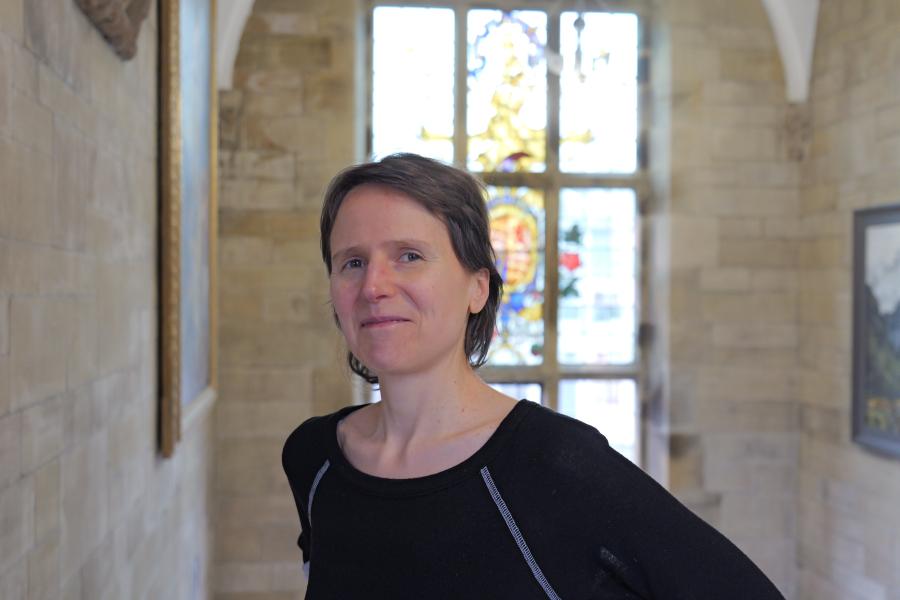
Dr Sarah Pogoda
We are a community here at Bangor, and we live it every day. Students and staff know each other well. We teach in small groups (particularly true for language classes) which allows us to really get to know each student, listen to their learning preferences and adapt our teaching to it. We also have a very creative approach to learning at Bangor, and there are lots of opportunities to engage in creative activities (e.g. curating an exhibition). Outside the classroom, we organise fun and inclusive social events, that allow us to get to know each other even better.
Enabling people to connect with people all over the world, enriching their experience and prospects by learning how they can shape their own future by speaking multiple languages and seeing the true diversity of cultures. Studying a modern language and cultures somehow means diving into a subculture, you learn about people, histories, arts and even economics. With this knowledge and all the skills for empowerment you gain with a degree in Modern Languages and Cultures, you equip yourself to pursue a unique and extraordinary life.
Cultures - Languages - Life changing

Dr Jonathan Ervine
I was passionate about languages and really keen to learn more about cinema annd politics in France. I wanted to be able to communicate well in France and explore the country, which I was able to do during time I spent there teaching English at primary, secondary and university level.
A lot of people think that do a language degree is just about communication skills such as writing and speaking. These are important parts of learning a language, but a big part of learning a language is about learning about another culture or cultures. You'll gain fascinating insights into places where a language is spoken and the people who speak it.
I've really enjoyed studying humour, and in particular stand-up comedy, in France. It's been amazing to see the range of different ways people use humour and the ways it can be both a source of controversy and something that has the potential to bring people together.

Guaranteed accommodation for Clearing applicants
If you apply through Clearing for a course that's based at our Bangor campus, you are guaranteed a place in University accommodation as long as you apply for a full-time course starting in September, apply for a course based at our Bangor campus and book a place in Halls by the closing date. Unfortunately, due to a limited number of rooms, we are unable to guarantee a place in accommodation at our Wrexham campus.

Visit The University Before Starting Here
If you missed our Our Clearing Visit Day and Open Day for Clearing applicants and would like to visit the University before starting here, please email us. By visiting the campus, you'll get a real insight into student life here and can familiarise yourself with the University buildings and Bangor itself.

How can you make friends before starting university?
Meet other applicants and be part of our Bangor student community even before arriving at Bangor! Join the Campus Connect app and you can ask questions, chat with current students and make friends with other applicants on your course and in your chosen accommodation. You'll be invited to join by email, which will also include your Bangor University reference number that you'll need to register.

Changed your mind? You're Not Alone
If you’ve met the conditions for your current UCAS choices but don’t feel it’s right for you, you can choose to go through Clearing. Explore your options at Bangor and fill in the online form to register your interest in Clearing or to apply for Clearing if you already have your results.
Already planning to join Bangor but thinking about a different course? We're here to help! Please fill in the online form.
