
Past and Future of Eryri Explored in Archives Annual Lecture
We are extremely proud of our doctoral researcher Alex Ioannou, who was invited to give the Bangor University Archives and Special Collections Annual Lecture on Wednesday, 12th of November 2025. Alex’s lecture entitled 'Challenging time(s): Exploring how we shape the past and future of Eryri through the exchange of material culture' provided a fascinating insight into his interdisciplinary doctoral research project, which is rooted in his case study area of Dyffryn Ogwen at the heart of Eryri National Park. Alex’s work connects current discussions about landscape change with the past, through historical evidence and archival material. Using this historical context as a foundation, Alex organised a series of engagement and knowledge-exchange activities with the people of Dyffryn Ogwen with the goal of ‘reframing’ contemporary attitudes and perceptions towards landscape and ‘disturbing’ dominant understandings to reveal a much richer and more varied understanding. His project therefore provides an alternative model for landscape decision-making which involves local people and communities.
Every year since 2011, Bangor University Archives and Special Collections has invited a speaker who has spent a substantial period of time researching a particular subject at the Archives or who specialises in a subject area of relevance to the department to deliver their Annual Lecture; a list of previous lectures and esteemed speakers can be viewed online. The 2025 speaker, Alex Ioannou, has made extensive use of the Penrhyn Estate collection as part of his doctoral project entitled 'Reframing Eryri in Praxis', a joint initiative of ISWE and the Sir William Roberts Centre for Sustainable Land Use, which shines a light on the ways Eryri has undergone change, from physical transformations to the more intangible changes in people’s perception of the landscape. Alex has also been working closely with the Archives over the past year as Research and Digitisation Assistant on a Welsh Government-funded project to digitise and provide online access to the Jamaica Papers within the Penrhyn Estate collection.
It’s a significant source of pride to have one of our doctoral students invited to deliver the BUASC Annual Lecture... Since joining us at ISWE, Alex has fully immersed himself in the Archives and through his research, collaboration, creativity and care has played an important role in shining a light on how this historical material can contribute meaningfully to some of the major challenges and issues of the present day.
After introductions from University Archivist, Elen Wyn Simpson, Alex paid tribute to the Archives team – which also includes Shan, Lynnete and Gwyn – and initiated a round of applause. This was especially touching in light of the events of the previous months, which saw substantial cuts to the Archives proposed in the University’s Business Case for Change, which were thankfully reversed to a large degree. The proposed cuts prompted a huge outpouring of support for the Archives from organisations, communities, and individuals across Wales, and beyond, including over 3,000 signatures on the ‘Save Our Archives’ petition, which was, incidentally, started by Alex!
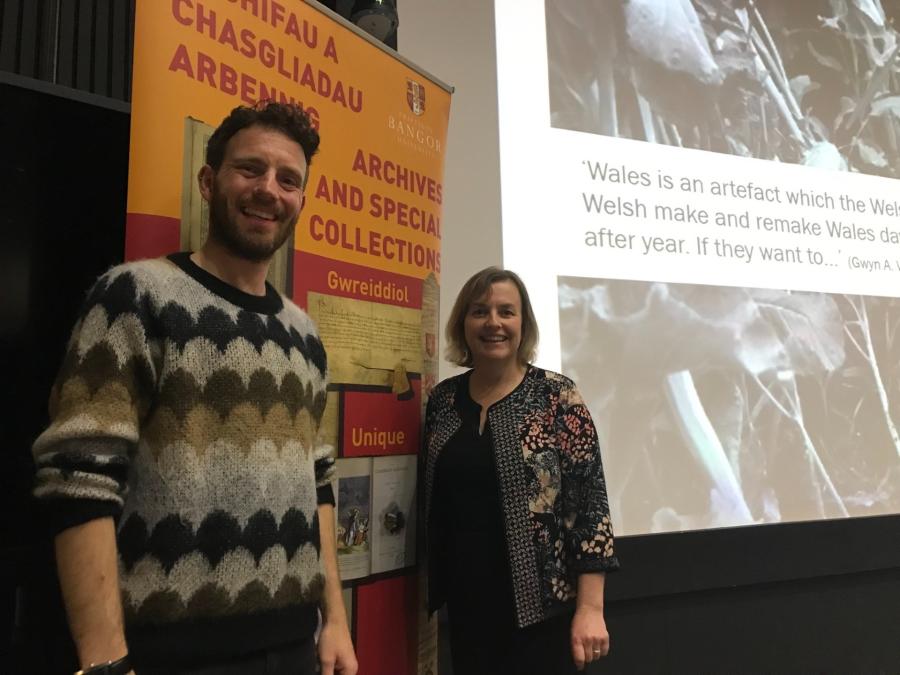
Alex opened his lecture by stressing the severity of the current climate emergency and its impact on the Welsh landscape, namely increased droughts, floods and heatwaves and a detrimental impact on the ecosystem. The Welsh Government has called this ‘the decisive decade’ to tackle climate change, which means that the way we manage our landscapes needs to evolve. Despite calls from the Welsh Government for ‘every citizen, community, group and business in Wales to embed the climate emergency in the way they think, work, play and travel’, Alex explained that, ultimately, when it comes land use decision-making the power still lies with the government, local authorities and government sponsored bodies. One of Alex’s main research questions is ‘how can decision making can be better informed?’ As it transpired over the course of his lecture, he strongly believes that local decisions can be better informed when more people are involved; however, local people and representative groups face significant barriers to participation in decision-making, even within their own square mile. Another of his key research questions is, therefore, ‘how can dominant ideas and power dynamics be challenged?’
Alex’s doctoral project has challenged the status quo, by developing and testing a best-practice approach to collaborative decision-making at a local level. His methodology involved conducting a series of engagement and knowledge-exchange activities in his case study area as a means of collaborative with local people in a creative and caring way. These included interviews with farmers, councillors and artists out in the landscape; a series of community knowledge exchange sessions in Bethesda, Mynydd Llandygai, and Tregarth; and an exhibition in Pontio in Bangor. This approach was a means of “bringing in knowledge that does not normally make it into the landscape decision-making system”, explains Alex.
Returning to the key research question of ‘how can decision making can be better informed?’, Alex explained that landscape decision-making is ultimately driven by expert judgement, scientific data and institutionally generated knowledge. One of the core principles of Alex’s project is that “landscape is a complex concept that involves not only the physical aspects”; it can’t just be understood in aesthetic and scientific terms. Alex argues that we have to “actively reframe” how we perceive landscape to acknowledge that it is imbued with memory and meaning.
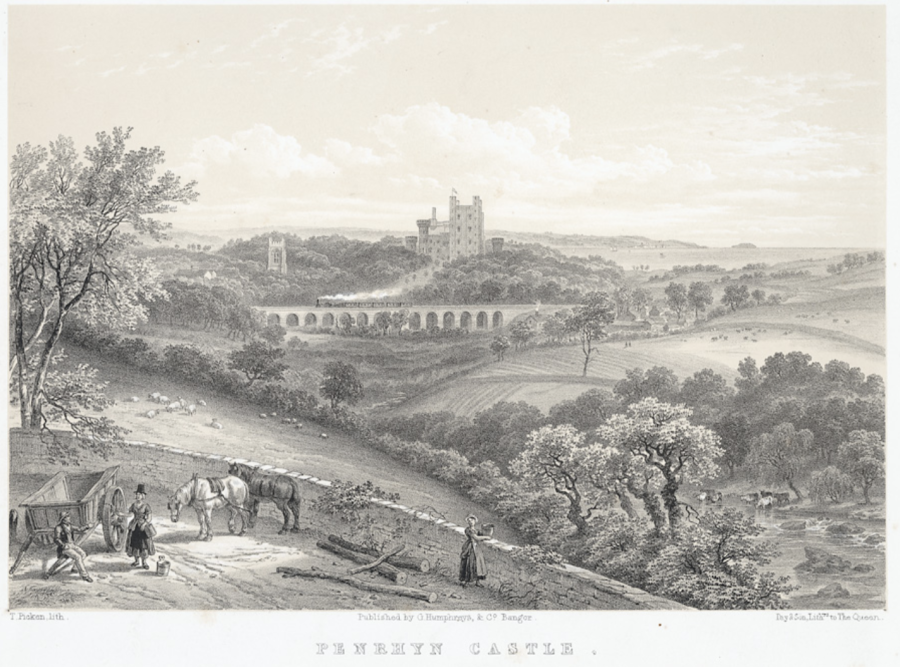
First, Alex looked at past change in the landscape. This included consulting secondary material to explore past understandings of human and landscape relations. He also undertook archival research, using the Penrhyn Estate collection at Bangor University Archives and Special Collections to reveal how the landscape of Dyffryn Ogwen changed across the period 1760–1951. His presentation described how the local landowners, the Pennant family of Penrhyn Castle, physically transformed the landscape through intensive farming, quarrying, building dams, establishing a transportation network; not to mention attracting hundreds of workers to the area, all of whom required accommodation. However, Alex also considered the change in perception of the landscape across this period, too. For example, at the beginning of the eighteenth century, Eryri was viewed as a place of danger and revulsion, described as ‘the fag end of Creation’. However, by the end of the eighteenth century Eryri was considered beautiful and picturesque and was attracting travel writers, landscape painters and tourists galore.
Next, Alex explained how the ‘official narratives’ of Dyffryn Ogwen are controlled by the landowners and the planning authority, including Eryri National Park Authority, Natural Resources Wales and the National Trust. Their websites variously describe Eryri as “beautiful and wild” in order to appeal to people’s senses; a “place of adventure and opportunity” to promote outdoor pursuits; and a “source of inspiration” for writers and artists. However, Alex argued that “this constructed narrative simplifies the social, political and economic conditions within Eryri, and reduces the complexity of past inhabitants’ relationship with the landscape”. Using the historical context he had collected from the Archives as a foundation for his engagement and knowledge-exchange activities, he set out to ‘actively reframe’ Dyffryn Ogwen, asking such questions as ‘what narratives are there of the communities and landscape of Dyffryn Ogwen?’ and ‘how do local people perceive and experience change in Dyffryn Ogwen?’. The goal is that this different type of knowledge will be fed back into the decision-making process.
To summarise, Alex’s project has developed a new approach to collaborative decision-making at a local level. Moreover, it has demonstrated that local decision-making pertaining to the landscape can be better informed through the incorporation of historical and personal perspectives. Not only was this a thought-provoking presentation, but it was extremely visually engaging, filled with photographs, maps, paintings and diagrams; there was even a short film shown at the half-way point! The work and archival material presented during Alex’s presentation can be seen in part within his online exhibition.
The Questions & Answers section of the evening began with a question about the future of tourism and the resulting pressures, to which Alex spoke about the power of reframing and questioning certain narratives about “locals vs tourists” to help alleviate tensions. Additionally, an audience member enlightened everyone by recounting the fact that their grandfather was a driver on the Penrhyn Estate railway.
Alex’s PhD Supervisor and Director of ISWE, Dr Shaun Evans, commented that ‘‘it’s a significant source of pride to have one of our doctoral students invited to deliver the BUASC Annual Lecture. The Archives are central to everything that we do as a research centre, and represent such a unique resource for the University. Since joining us at ISWE, Alex has fully immersed himself in the Archives and through his research, collaboration, creativity and care has played an important role in shining a light on how this historical material can contribute meaningfully to some of the major challenges and issues of the present day. Together with everyone at ISWE I extend my warmest congratulations to Alex and continuing gratitude to the Archives team for everything that they do.’’
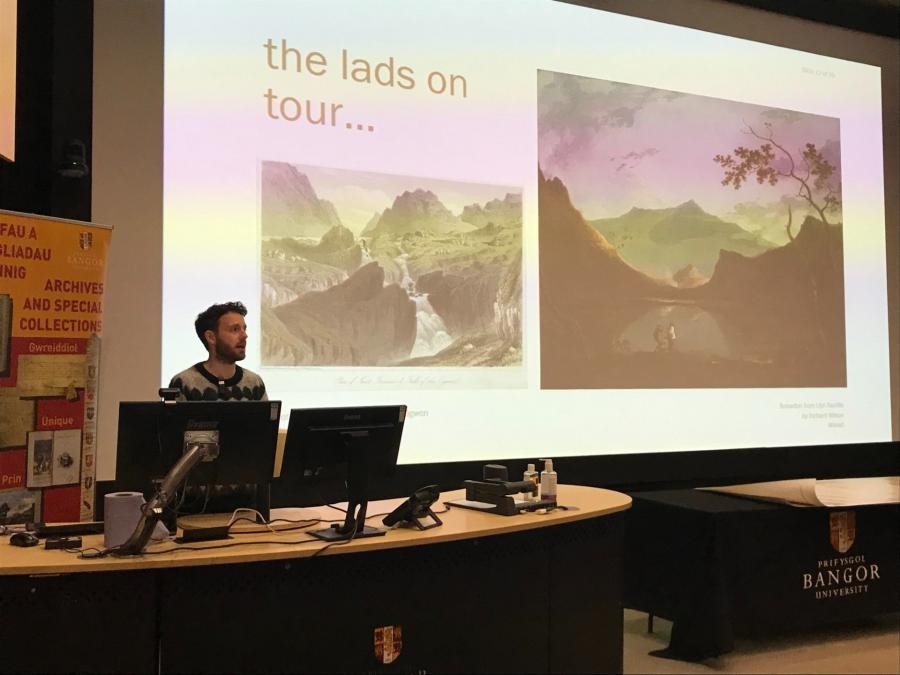
Alex said that: “Being invited to deliver the BUASC Annual Lecture was a humbling thing, as well as a great honour. I want to thank the Archives and Special Collections Team for their continued support. Without their expertise and patience my research would not have been possible. It was a joy and a pleasure to present my findings to an engaged audience of local people. The archives here at Bangor are special and being able to play a small part in helping reveal what they hold about the local area is also special. I would like to also thank my supervisor Shaun for his encouragement and help throughout the years".
(Authored by Dr Bethan Scorey, with thanks to Alex Ioannou)