
This is one of the conclusions drawn from brand-new research by leading health economists at Centre for Health Economics and Medicines Evaluation at Bangor University and researchers at Edge Hill University into the vital role the arts play in supporting public health and reducing pressure on essential services alongside delivering considerable wellbeing benefits to people of all ages.
This is first time the economic impact of the arts on the NHS and social care in Wales has been investigated at a national level, and the research was commissioned by Arts Council of Wales.
The independently-conducted report ‘Assessing the Economic Impact of the Arts on Health and Healthcare Services in Wales’ shows that engagement with the arts delivers at least £588 million in annual health and wellbeing benefits across Wales. The analysis applied recognised national models, used conservative assumptions throughout, and concludes that the true benefits are likely higher.
The report, which used population data and attendance and participation data provided by Arts Council of Wales, also found that:
- Arts Council of Wales’s investment in multi-year funded organisations (which include arts organisations and venues across Wales) generates a financial ROI of £11.08 in for every £1 invested in terms of health, wellbeing and productivity benefits.
Evaluations of specific Arts Council of Wales funded projects that target particular health conditions indicate: - A dance for strength and balance programme has the potential to save £5m a year in healthcare costs by preventing falls amongst the elderly.
- If arts programmes could reach 5% of young people in NHS mental health pathways, this would generate annual mental health and wellbeing benefits of £9.5m.
- If 5% of all adult mental health GP appointments were avoided following engagement in the arts, this would save £17m per year.
Arts programmes that support the health and wellbeing of NHS staff have the potential to save up to £3.5m a year through reductions in staff sickness and attrition costs.
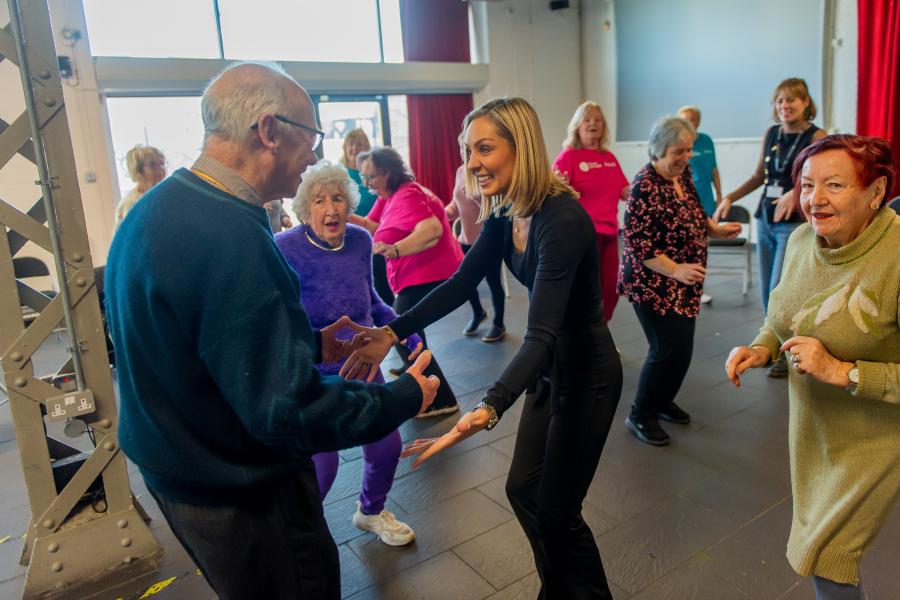
Professional Dancer Amy Dowden, Dance to Health Teacher Emma Jenkins and class participants. Professor Rhiannon Tudor Edwards, Co-Director of the Centre for Health Economics and Medicines Evaluation, School of Health Sciences, Bangor University, said: “This analysis is grounded in rigorous economic modelling, established national frameworks and conservative assumptions throughout. Even using cautious estimates, the evidence clearly shows that the arts deliver substantial and measurable benefits to population health and to our health and social care system. As independent health economists, we have provided evidence to support the strong case for including the arts within preventative health strategies in Wales.”
Dafydd Rhys, Chief Executive of the Arts Council of Wales said: “The arts are delivering real, tangible health benefits for people and communities—and now we have the independent, robust evidence to prove it. This is a landmark moment for the sector and for public health in Wales.”


