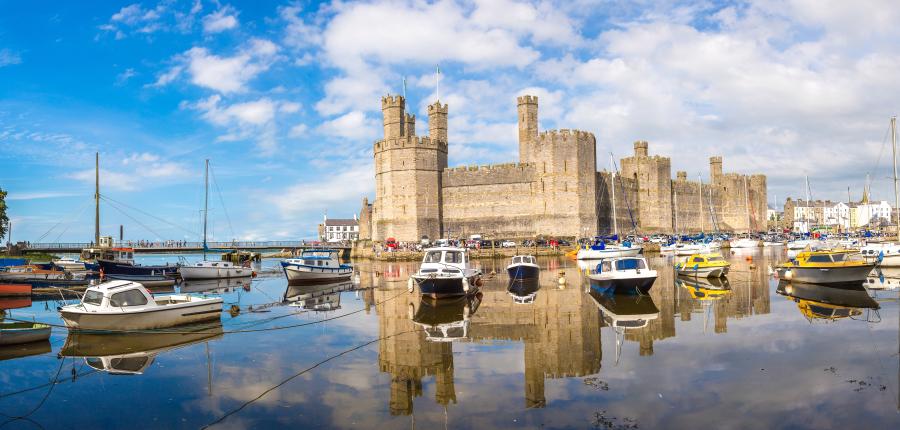
Short Course: Historic Landmarks of North Wales
We are pleased to promote this free, 4-week short course being run by Bangor University, which includes a session led by our Director Dr Shaun Evans.
The course explores how landmarks, both historic and contemporary, carry meaning, memory, and power. Through four themed sessions, learners will examine landmarks as places of authority, celebration, infrastructure, and expression, considering how people have shaped, used, commemorated, and contested significant sites over time.
Beginning with the medieval Welsh llys as a centre of princely power and cultural life, the course then moves to personal and collective “coming of age” memorials, exploring how life transitions are marked and remembered. Learners will also investigate how everyday infrastructures can evolve into cultural landmarks, before concluding with an examination of graffiti on landmarks as a form of communication, protest, and identity.
Across the course, participants are encouraged to think critically about whose stories are represented in landmarks, how meanings change over time, and how history, memory, and lived experience intersect in the built environment.
Please register your interest using the link provided, and the University will be in touch with further information.
Dates and time
Dates: 24/02/2026 – 17/03/2026
Time: 6.00PM – 8.00PM
Week 1
Landmarks of princely power: the medieval Welsh llys
Lecturer: Dr Euryn Roberts
Duration 2 hours
Course Overview
This short course explores the medieval Welsh llys (princely court) as a centre of power, governance, culture, and daily life in medieval Wales. Through historical sources, law texts, poetry, and archaeology, learners will discover how Welsh princes ruled, how their courts functioned, and what life was like for those who lived and worked within the llys. The course also considers how the Welsh court compared with contemporary English and European courts.
Designed for adult community learners, no prior knowledge of medieval history or Welsh is required.
Learning Outcomes
By the end of the course, learners will be able to:
- Explain the role of the llys in medieval Welsh society as a centre of political authority and governance.
- Identify key figures within the princely court (such as the prince, teulu, poets, judges, and officials) and describe their functions.
- Describe everyday life at a medieval Welsh court, including hospitality, feasting, law, and cultural practices.
- Understand the importance of law, poetry, and patronage in sustaining princely power and Welsh identity.
- Compare the Welsh llys with other medieval courts in Britain and Europe.
- Engage critically with historical evidence, including medieval law codes, poetry, and archaeological remains.
Week 2
Estates, Monuments and the Making of the Welsh Landscape
Lecturer: Shaun Evans
Duration: 2 hours
Course Overview
Taking inspiration from W. G. Hoskins’s seminal work on The Making of the English Landscape, this short course explores the influence of estates in making and shaping the landscapes of north Wales. Through the ownership of land, the gentry and aristocracy of Wales had significant capacity to control elements of its appearance, management and use. This is best reflected in building of their country houses, often surrounded by walled parkland with ornate gateways and lodges. This course, however, will explore another element in the gentry’s fashioning of the landscapes and townscapes of Wales: the construction of monuments designed to commemorate and celebrate. These took the form of grand columns and obelisks, clocktowers, drinking fountains and follies. All became prominent landmarks in their localities.
Drawing on historical examples including the Pillar of Eliseg near Llangollen, Bulkeley Monument in Beaumaris, Alleluia Monument near Mold, Anglesey Column, and Machynlleth Town Clock, the course will explore why these monuments were erected or restored, how their design and appearance sought to inscribe status, meaning and memory into the landscape, and the role of communities in their construction and commemoration. Participants will consider why certain events and individuals were celebrated, recorded, or even mourned, and how memory, identity, and place shape these memorials.
Learning Outcomes
By the end of the course, learners will be able to:
- Identify different historical examples of estate-based monuments across north Wales.
- Understand the historical influence of estates in controlling elements of the Welsh landscape.
- Explain why communities chose to commemorate particular events and individuals, and how these practices reflect values, identity, and belonging.
- Recognise the role of landscape in preserving memories, shaping identities, and making places.
- Reflect critically on wider practices of commemoration and memorialisation.
Week 3
When Infrastructures Become Landmarks – Karin Koehler
Lecturer: Dr Karin Koehler
Duration: 2 hours
Course Overview
Infrastructures, such as bridges, roads, power stations, dams, railways, and digital networks—are often designed for utility rather than beauty. Yet over time, some infrastructures take on cultural, social, and symbolic meaning, becoming landmarks that shape identity, memory, and place. This course explores how and why infrastructure can transform into landmarks, and what this tells us about society, values, and everyday life.
Learning Outcomes
By the end of this 2-hour course, learners will be able to:
- Explain what is meant by infrastructure and landmark, and how these concepts intersect.
- Identify examples of infrastructures that have become landmarks locally, nationally, or globally.
- Understand the social, cultural, historical, and political processes that contribute to this transformation.
- Reflect critically on how infrastructure shapes personal experience, community identity, and memory.
- Discuss whose values and perspectives are represented—or excluded—when infrastructures become landmarks.
Week 4
The Meaning of Graffiti on Landmarks
Lecturer: Dr Karen Pollock
Duration: 2 hours
Course Overview:
This short course explores graffiti found on landmarks as a form of communication, protest, identity, and historical record. Participants will examine why people mark significant places, how meanings change over time, and how institutions and communities interpret graffiti differently. Through case studies and discussion, learners will consider graffiti not only as vandalism, but also as cultural expression and social commentary.
Learning Outcomes
By the end of this course, participants will be able to:
- Identify different types of graffiti found on landmarks and historic sites.
- Explain social, political, and personal motivations behind graffiti.
- Analyse how context (place, time, audience) affects the meaning of graffiti.
- Evaluate differing perspectives on graffiti, including heritage, legal, and community viewpoints.
- Reflect on whether graffiti on landmarks should be preserved, removed, or reinterpreted.