Cochwillan History Explored in ISWE Fieldtrip
On the 5th of February 2026, a group of ISWE doctoral researchers and friends had the pleasure of visiting Plas Cochwillan near the community of Tal-y-Bont in Gwynedd, one of the finest late-medieval gentry hall houses in Wales, followed by the former estate cornmill Felin Cochwillan. In this blog post, Doctoral Researcher Anna Reynolds tells us all about the fascinating afternoon!
Plas Cochwillan
We visited the old Cochwillan estate on a leaden, freezing February day, with snowdrops pushing their heads through wet grass and sheep huddled under the broad concrete span of the A55 for shelter. Our first site to visit was the impressive, privately owned, mediaeval hall house of Cochwillan, so our little convoy of cars crawled down the unmade track and parked where we could on sodden grass and mud. Horses might have fared better.
To the inhabitants of nearby Penrhyn Castle, Plas Cochwillan must have looked like a lowly place, but when it was first built in the late-fifteenth century it would have been a very fine hall. The first thing that strikes you on the approach, now to the rear of the building, is the solid, enormous and angular chimney stack rising from the great fireplace that would have heated the vast space. The hall was probably built after the period of open hearths venting through a hole in the roof. All mod cons, Cochwillan boasts a beautiful, broad fireplace with a moulded beam to the side of the room, fine mullioned windows, and a hammer-beam roof described by Peter Smith in Houses of the Welsh Countryside as the most impressive and probably the oldest of its type in north Wales.
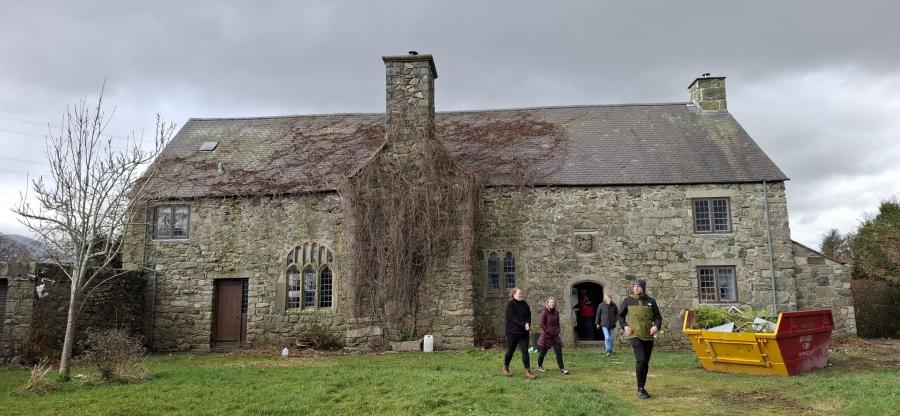
Cochwillan was built for Gwilym ap Gruffydd in the fifteenth century, but there was a building on the site from the thirteenth century. The buttery and solar to the west end and the chamber to the east were slightly later additions, and the current building is missing two wings originally forming a courtyard plan with the remaining range. Despite these losses and additions, the hall, the nucleus of the site, is stunning.
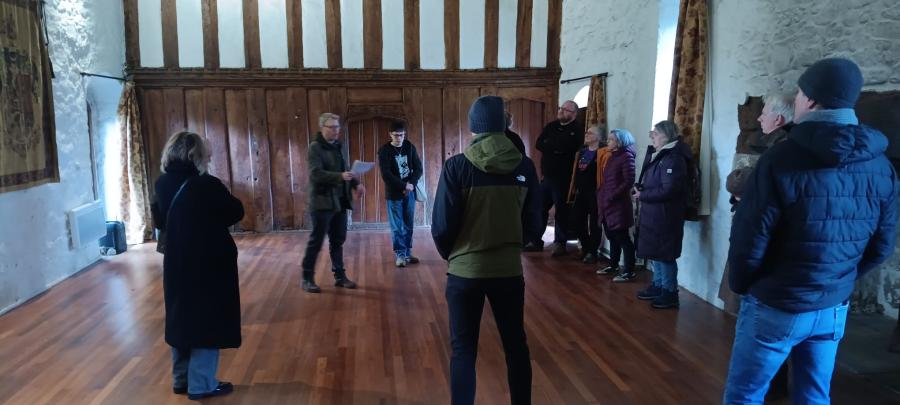
ISWE's Director Dr Shaun Evans gave us some of the history of the place, talking about its origins as part of what became the Gruffydd of Penrhyn estate, its acquisition by Archbishop John Williams, and how the Welsh language praise-poetry performed within its walls provides insights into the social and cultural life of the building. The house was renovated and restored in the 1970s, having been reduced to a barn, possibly as early as the eighteenth century , but when it was built Gwilym ap Gruffydd was one of the leading uchelwyr of the country, raised to the status of Sheriff of Caernarfonshire for life, and given English citizenship following his support of his distant cousin, Henry Tudor, at the Battle of Bosworth in 1485. In the lifetime of Gwilym and his Williams of Cochwillan descendants, the building would have been the site of politics, hospitality and praise poetry.
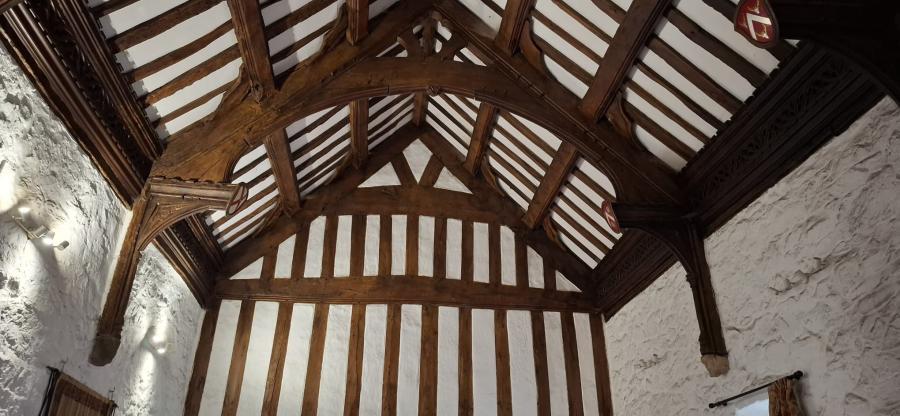
The hall itself is a high, open space, the original hammer beams sporting heraldic shields on their ends introduced as part of the restoration, but painted to represent the old families and ancestors of Cochwillan; including three Englishmen’s severed heads for Ednyfed Fychan and three deer heads for Iarddur, the original ancestral proprietor of the land upon which the hall stands. Another, original wooden carving above one of the doorways depicts the arms of Marchudd ap Cynan, from whom Edynfed Fychan claimed descent. A beautiful, intricate pieced frieze runs along the edges of the ceiling, and the beams are supported on carved stone finials, frozen faces looking down on the living ones below.
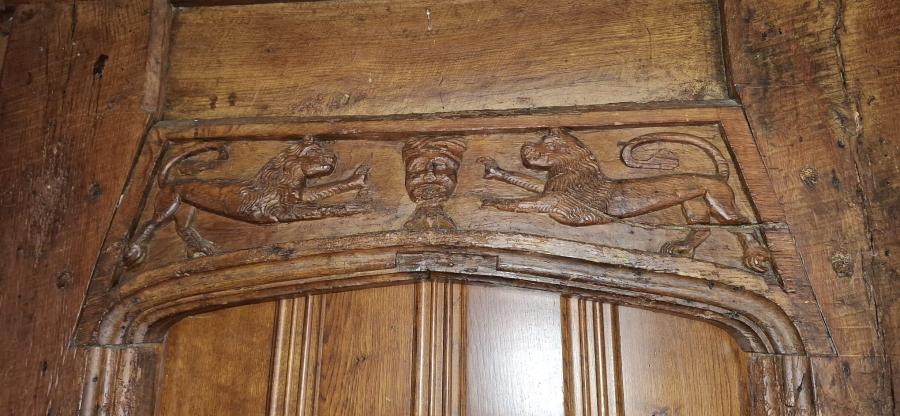
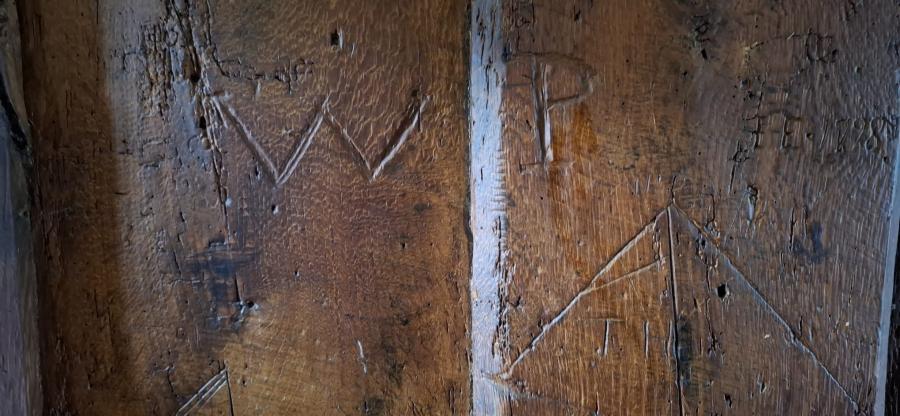
The space is bounded at either end by impressive oak screens, the western screen in much better condition at the time of restoration than the east, which had lost almost all of its plaster. Rather wonderfully, the western screen has also preserved small instances of graffiti in the form of a line-sketch ship, initials such as a carved ‘W P’, and apotropaic scratches and scorch marks meant to protect the building from evil forces, perhaps placed here because it is this screen which edges the cross passage, with a door to the outside at either end. The heavy oak beam above the main fire, too, bears a number of these scorch marks, which would have prevented evil from entering through the vulnerable point of the chimney. The smaller fireplace in the western solar also bears similar marks, although the original parlour and stair area below have undergone substantial alterations.
The eastern end of the building beyond the partition has lost almost all of its original features, bearing the aspect of a rather neglected rental property, with an unsympathetic laminated wood spiral staircase, patterned carpets, and walls in faded yellow. In one room a limp white muslin curtain is looped back by a string of brittle fairy lights like a crown of thorns, and empty built in cupboards have an abandoned air. It’s like stepping into another world.
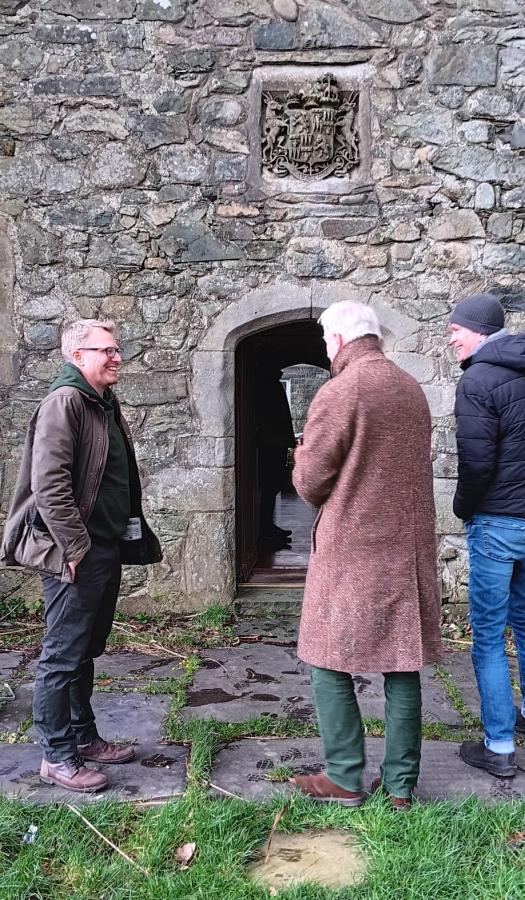
Back in the main hall after some over-excited exploration of empty rooms, barns, and winter-bare grounds, Dr Meinir Moncrieffe told us a little of Cochwillan’s more violent past, and the house’s connection with Gwydir. In the sixteenth century there was a marriage between Agnes, daughter of John Wynn ap Maredudd of Gwydir, and William Williams of Cochwillan, but it wasn’t to be a happy union. Like many marriages of the time, this was a match of convenience rather than love. Agnes’s nephew Sir John Wynn of Gwydir suggested that her death was at her husband’s hands, a victim of domestic violence. This idea, Dr Moncrieffe told us, was supported by Wiliam Cynwal’s 1572 Welsh elegy poem, or marwnad, which reads ‘Ac Anes wen a gwynyn, gloyw am waed, gwraig William Wyn.’ This can be interpreted as referencing ‘blessed Agnes, glistening from blood’, elevating her, perhaps deservedly, to position of martyr.
Standing in the cold hall and touching the smooth, age-old wood you feel connected to the bones of the past, but it’s the stories of the lives and the deaths in houses like this that truly bring them to life. Later eighteenth- and nineteenth-century probate inventories show families of more modest means and more mundane possessions living between these walls. Lists of potatoes, feather beds, earthen vessels, milk cows, and mountain sheep, show a fall from grand residence to humble farm. But the will of Owen Williams in 1832 contains a ‘well beloved’ wife Elizabeth Parry, not a woman meeting her end through violence.
Plas Cochwillan is currently vacant. The Penrhyn Estate is considering options for its future use. The very nature of the building and its location provides significant challenges, not least relating to heating, but a building of such splendour and significance surely has a role to play in the future of its community, and for Wales.
Felin Cochwillan
We moved on in our small convoy through the winding lanes to Felin Cochwillan, another privately owned property kindly opened up to us by Cora and Howard Hutchinson for our visit. Somewhat newer than the hall house, this iteration of Cochwillan Mill was built only two centuries ago, but there has been a mill on the site from at least 1560. The site is perfectly positioned to take advantage of the torrents of Afon Ogwen as it flows from the Eryri mountains under a high crumbling cliff of earth and stone.
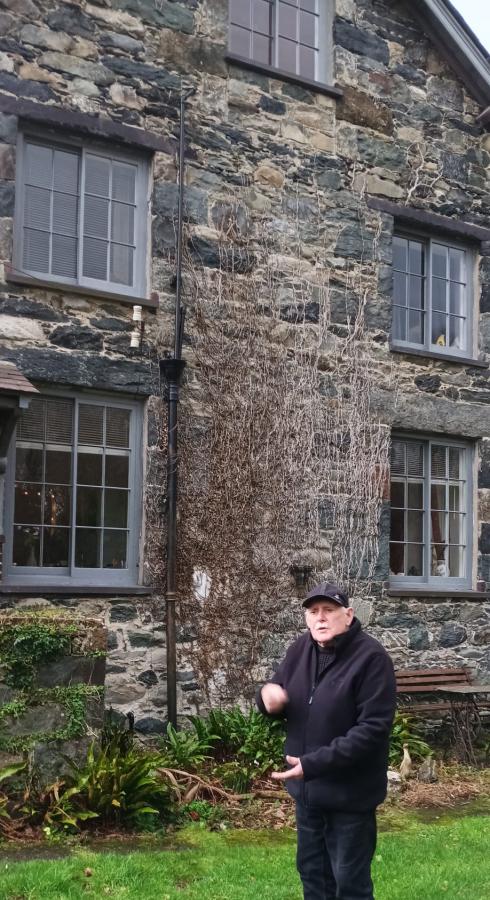
We gathered outside in the dank cold while Howard told us how his uncle acquired the property in 1955 for £500 from the Penrhyn Estate when they were raising money to pay death duties. ‘He only bought it for keeping bees,’ he said, but the place became much more than that. At first there were no services, and Vernon Barker drank the water from the river. Half a restoration project and half functional space, the interior of the building is an eclectic mix of original mill workings, tools, display boards, and a small collection of the weaving and spinning paraphernalia that Uncle Vernon had been fascinated by along with bees.
Proving the urge to scribble is universal, this property too supports graffiti on its old wood. The door to the dark space containing the water wheel gears is adorned with little pencil drawings of horses, various inscriptions, and a sketch of a rather fine moustachioed gentleman in top hat and neckerchief.
Upstairs, more original workings remain in situ. Earlier in its life the place was a fulling mill, processing woollen cloth to clean and tighten the fabric for use, but after an early example of the problems of pollution – the chemicals used were damaging to Lord Penrhyn’s beloved salmon – the mill was turned to grinding corn instead. It’s in this form that the building is preserved.
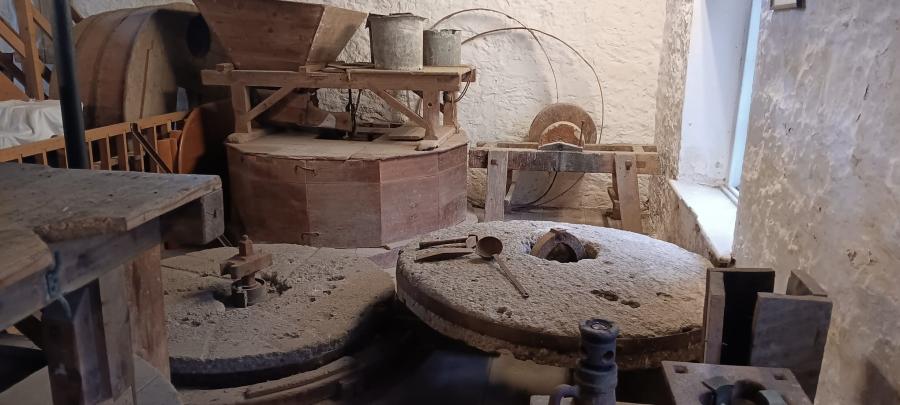
On the first floor great, weighty millstones sit near the windows, the stone rough and obdurate under the fingertips, fit for grinding grain. Higher quality French stones would have been used for wheat, with more local and rougher grades for barley and oats. Every six months these wheels were re-dressed. When the itinerant workmen came to do this, Howard told us the miller would demand, ‘Let me see your arms of steel.’ The blue metallic scars from the hot chippings were ‘his CV’ and he got the job.
A ladle lay on top of one stone, which, after dressing, would have been used to pour molten lead into cavities in the stone to balance it precisely. Various rusted metal wedges or tools were ranged along the windowsills, and a worn wooden shovel sat against the wall, perhaps once used for shovelling grain.
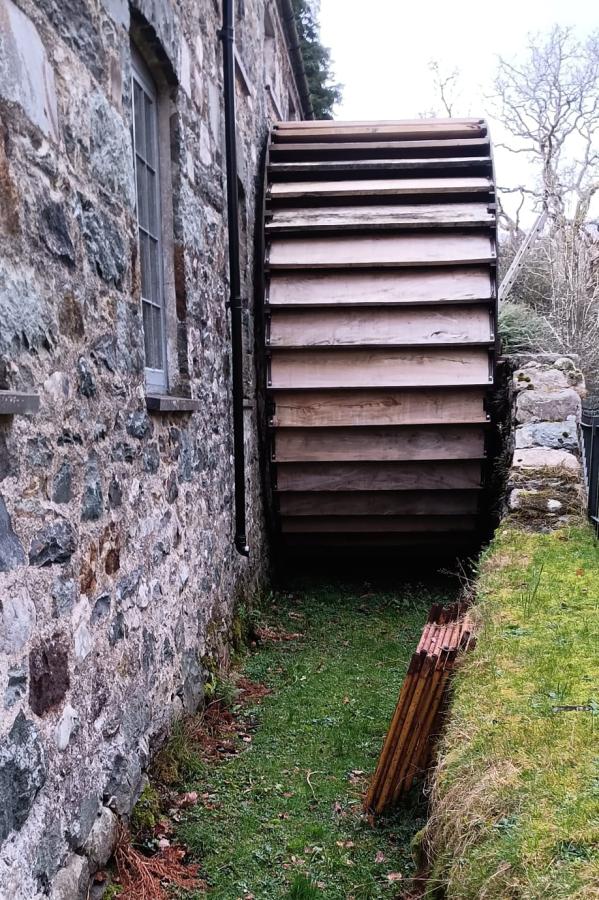
Outside, the sound of the river, swollen with winter rain, was a constant presence, although invisible across the wet field. Here is more evidence of the slow and ongoing restoration process. We filed around the side of the building for Howard to show us the great mill wheel, more than twice as tall as the tallest of us there. This is an under-shot wheel, with the water brought to just above halfway up the great height by a constructed channel. The wheel, Howard told us, has been recently rebuilt with the last of the Welsh elm available before Dutch elm disease destroyed the native trees.
The trees are coming back, and the wheel is now a fine, solid construction, just waiting for the water to turn it. Howard’s uncle had hoped, aged 80 in 1988, that the project would be finished ‘in two or three months’. It’s proving to take a little longer, but the determination of the nephew is that one day the wheel will turn again. For more information visit the Felin Cochwillan website.
Reflections
Reflecting on the visit, ISWE’s Director commented that ‘‘It was a real pleasure to visit these two neighbouring buildings, reflecting very different but nevertheless integral aspects of an estate’s history, character, operations and identity. These fieldtrips are such an enriching part of ISWE: the different sites encourage our researchers and students to share perspectives from their own projects, often inspire further exploration and enquiry, and always expand our appreciation of estates as part of the historical and contemporary fabric of Wales. We’re ever so grateful to Cora and Howard Hutchinson and the Penrhyn Estate for facilitating the visit.’’
(Authored by Anna Reynolds)