

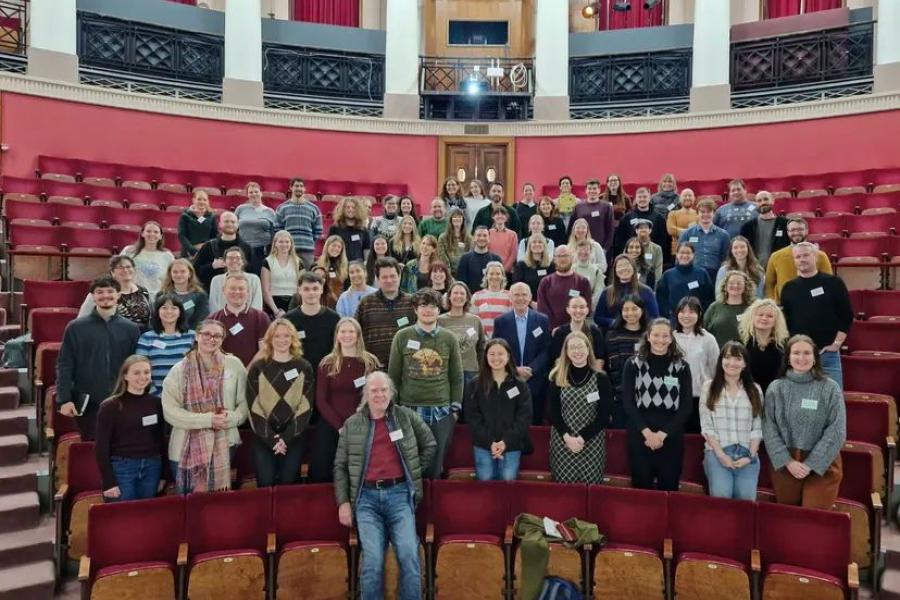
The Winter Meeting of the PSGB was held at the National Museum Cardiff on 27 and 28 November and was organised by primatologists from the University of South Wales, Swansea University and Bangor University.
Patrick Allsop, PhD student, won an award for best student talk and Billie-Mae Fisher, MScRes student, won joint-best student poster – both for their research with the Zanzibar Red Colobus Project (ZRCP). This research is dedicated to studying and contributing to efforts to conserve the Zanzibar red colobus — an endangered monkey species endemic to Zanzibar — by investigating how human-caused habitat changes affect their behaviour, physiology, ecology and long-term survival.
The prizes for the winning students – academic books – were provided to the PSGB by Cambridge University Press.
The Winter Meeting of the PSGB was held at the National Museum Cardiff on 27th-28h of November and was organised by primatologists from the University of South Wales, Swansea University and Bangor University.
Patrick Allsop won the best-15-min student talk for his talk presenting the first study of the microbiome of the Zanzibar red colobus monkey. Patrick examined the relationship between the different plant foods the colobus living in different habitats eat and the composition of the bacterial community (microbiome) in their guts – which form an essential part of the digestive system that also have wide-ranging repercussions for individual health.
The research Mr Allsop presented at the PSGB meeting is the result of 15 months spent in Zanzibar between 2022 and 2025 following eight groups of endangered and endemic Zanzibar red colobus monkeys, observing their behaviour, and collecting faecal samples to characterise their diet and the gut microbiome using cutting-edge metabarcoding techniques. This study provides the first examination of how anthropogenic disturbance and dietary shifts interact to affect the microbiome of this species.
Reflecting on his prize, Patrick Allsop said: “I am astounded to have been picked for this award out of so many great talks at the conference! I’d very much like to acknowledge the crucial contribution that the ZRCP field team of Zanzibari field assistants made to this work and the effort my supervisors in Zanzibar and at Bangor put in to help with my thesis research. It's a privilege to be able to conduct field work in one of the most fascinating places in the world and to work with these amazing animals.’
Billie-Mae Fisher won joint-best poster prize at the PSGB meeting, for her study of the effects of tourist presence on the Zanzibar red colobus monkeys. The work Billie-Mae presented was a result of her third-year dissertation research as an undergraduate student at Bangor in 2024/25. Using long-term data collected by the ZRCP, Ms Fisher showed that when large numbers of tourists visit the monkeys to observe them in the wild, the colobus tend to spend less time resting, and more time travelling. These analyses are an important extension to our knowledge of how primates exposed to frequent human disturbances may respond.
Billie-Mae said: “This project was a major part of my academic journey and studying how tourists affect Zanzibar red colobus behaviour reminded me of the importance of reflecting on our interactions with wildlife. I’m incredibly grateful to have this research recognised at such a respected conference.”
Three other Bangor students also presented their work at the Winter Meeting of the PSGB in Cardiff. Owen Storer (PhD student) spoke about his work on the effects of habitat disturbance on colobus gastrointestinal parasite infections. Danielle Bayles discussed her insights on how the colobus living in heavily built-up and modified habitats on the coast adjust their foraging strategies to this new environment. Molly Allum described her findings on how colobus living at the edge of the forest adjust to the risk of foraging in crop-fields in the nearby villages, where they are exposed to potential predation by dogs and of crop-guarding by farmers.
Dr Alex Georgiev, who directs the Zanzibar Red Colobus Project was delighted with the success of Bangor University students at the PSGB meeting: ‘As a supervisor, seeing my students present their research at the PSGB meeting was a personal highlight. As a primatologist, having the opportunity to share the work that our team has been doing on the Zanzibar red colobus has also been very rewarding. It is through this incremental accumulation of multiple, focused field studies that we will be able to really understand how this endangered species is coping in heavily modified habitats and, hopefully, to contribute to protecting this monkey from extinction!’.
All four Bangor students who presented at the PSGB meeting in November are currently working on submitting their findings for publication in peer-reviewed journals.


