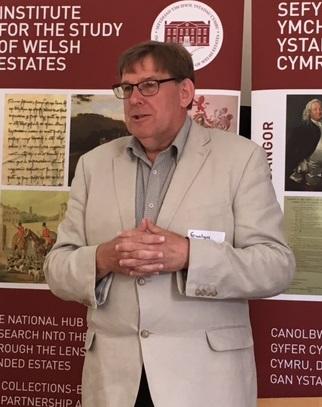
Dr Gwilym Owen
Everybody associated with ISWE is deeply saddened to hear that Dr Gwilym Owen passed away on 11 August 2026. Until very recently, Gwilym held the position of Senior Lecturer in Property Law, Equity and Trusts at Bangor University. He had previously practiced as a Solicitor in north Wales for 30 years, specialising in property litigation, before being appointed to a lectureship at Bangor in 2011. He attained his PhD by publication in 2017. With expertise in Welsh legal history and land law, Gwilym was a key member of the ISWE team, and one of our keenest supporters, for over a decade.
During his time in academia, he developed a fascinating corpus of research focusing on the transition between and intermixture of Welsh and English law, and legal culture – especially in relation to land law and inheritance practices – in late medieval Wales, across the implementation of the Act of Union of 1536 and 1543, and long afterwards.
This focus underpinned many of the collaborations and friendships that defined Gwilym’s approach to research and publication.
Several of Gwilym’s early publications explored the dynamics of Welsh medieval property law, including the operation of cyfran (partible inheritance) and tir gwelyog (hereditary land), and the gentry’s use of conveyance in tir prid for the building of their estates.
This formed the basis of a fruitful collaboration with Prof. Huw Pryce on ‘Medieval Welsh Law and the Mid-Victorian Foreshore’, published in the Journal of Legal History, which analysed the employment of Cyfraith Hywel (Welsh medieval law) in a 1862 legal case concerning disputed foreshore rights in Anglesey, in connection with the Brynddu estate.
The perseverance of Welsh law, or at least the retention of a Welsh legal mindset, following the political and legal incorporation of Wales with England in the mid-sixteenth century, formed an important subject of enquiry, which Gwilym explored through publications and conference papers on settlement patterns and the ‘Welsh Mortgage’. In these works, he argued forcibly that late-medieval and Tudor Wales (before and after the Act of Union) were characterised by the coexistence and interplay of both Welsh and English law. In recent years, Gwilym has worked with the Polish legal history, Dr. Łukasz Korporowicz, to identify international historical alignments and comparisons relating to the use of settlement, law of entail and forms of mortgage.
In a long and fruitful collaboration with archivist Peter Foden, Gwilym made use of estate records (held by Bangor University Archives and Special Collections, The National Archives, and elsewhere) to undertake a detailed analysis of settlement practices and inheritance disputes on the Gruffydd family’s Penrhyn estate during the fifteenth and sixteenth centuries, published by the Welsh Legal History Society in 2019 under the title, At Variance: The Penrhyn Entail. A fuller historical account of the long-running legal contest for Penrhyn, again co-researched with Peter Foden, will shortly be published in the Transactions of the Caernarvonshire Historical Society.
Gwilym followed his study on the Penrhyn entail with an exploration of the litigation associated with the various marriages of Edward Griffith (d.1540) of Penrhyn, working with Prof. Rebecca Probert to contextualise Griffith’s approach and attitude with reference to both Welsh medieval law and Henry VIII’s contemporaneous ‘Great Matter’, centred on attempts to annul his marriage with Catherine of Aragon.
These studies emphasised to Gwilym the value of estate records for advancing understandings of the real-world applications and practices of law in late-medieval and early modern Wales. Working in partnership with Dr Shaun Evans, Dr Julie Mathias and Dr Sarah Higgins, he led a series of ESRC-funded workshops on estate archives for ISWE, at Glamorgan Archives, the National Library of Wales, and Bangor University. He later developed this research through an (unsuccessful) application to the AHRC which would have used title deeds as the basis for a seminal study of women’s engagement with property law, and legal culture, in fifteenth- and sixteenth-century Wales.
Another collaboration, with Dr. Nerys Llewelyn Jones, focused on the late nineteenth-century campaign for separate agricultural legislation for Wales, centring on the case for a Welsh Land Court and the proceedings of the Royal Commission on Land in Wales. Gwilym also worked closely with his colleague Dr. Marie Parker-Jones on research into the legal principle of ‘proprietary estoppel’, exploring its origins through an 1862 legal case (Dillwyn v Llewelyn) centred on the Hendrefoilan estate in Swansea. In 2025, Gwilym again partnered with Peter Foden to develop research on the history of Welsh manors and manorial records, which they presented at a special conference hosted by the University of Cambridge to celebrate 100 years of the seminal 1925 property legislation.
Gwilym was a Fellow of the Royal Historical Society and member of the Welsh Legal History Society, Legal Wales, European Society for the History of Law and European Society for Comparative Legal History. Between 2017 and 2023 he served as Undersheriff for Gwynedd. He was extremely proud to be a member of Côr y Penrhyn, and recently assembled a history of the choir, available on its website.
He retired from his position at Bangor University in spring 2026, following a terminal cancer diagnosis.
On 30 July 2026, Bangor University hosted a special lecture in Gwilym’s honour, co-hosted by the Institute for the Study of Welsh Estates, Welsh Legal History Society and North Wales Law School – three of the bodies that he made into his ‘home’ during his time in academia. The lecture was delivered by Prof. Gwen Seabourne, Professor of Legal History at the University of Bristol, on the theme of ‘Mystery, Mortgages and More: A View of Welshness, Land and Law’.
The paper brilliantly drew together strands of Gwilym’s scholarship, exploring the nature and employment of the ‘Welsh Mortgage’ and pointing to further research in Welsh legal history and land law that can develop out of the foundations established through Gwilym’s endeavours. To this end, in 2025 Gwilym kindly deposited a small but significant collection of his legal history books with ISWE, so that the legacy of his scholarship can endure for years to come.
It was wonderful to have Gwilym in attendance as the guest of honour for what was a very special occasion, attended by his family and so many of his friends, colleagues and former students. Dr. Shaun Evans of ISWE introduced the event by thanking Gwilym for everything that he had contributed towards Bangor University and the communities of knowledge, learning and research that he had built around himself during his time in academia. Gwilym’s collaborative and collegiate approach to research, his generosity in sharing his expertise with others, his passion for his subject, kindness, humour, and continual wiliness to learn, exemplify everything that academia should be.
Dr. Hayley Roberts, newly-apointed Head of the North Wales Law School, and one of Gwilym’s former students, concluded the Special Lecture by reflecting on his enormous contribution to the Law team at Bangor, the affection held towards him by his students, and his charisma in bringing the teaching of legal history to life within the classroom. Dr. Roberts formally conferred an Honorary Readership on Gwilym, on behalf of the University.
Over £2,500 was raised in donations for the Arfon District Nursing Team through the North Wales NHS Charity, Awyr Las, as part of the event.
Gwilym will be greatly missed by all of us.
He was a truly wonderful person.
We send our deepest condolences to his wife, Helen, his son, Gwyn, daughter, Manon, sister, Sian, mother, Heulwen, and all his family.
Heddwch i’w lwch.