ISWE Annual Lecture 2026: Lady Llanover and the Reinvention of Wales
On Tuesday, 5th May Dr Marion Löffler enthralled the audience at Bangor University and online with her lecture titled ‘Lady Llanover and the Reinvention of Wales in the Nineteenth Century’. Our Annual Lecture is a chance to share recent and ongoing research on themes which are important to us as an Institute, and Dr Löffler’s presentation combined two of our primary interests: women’s history and the role that the Welsh gentry played in shaping the identity of Wales. We are pleased to share this summary report of proceedings.
The inaugural ISWE Annual Lecture was delivered in April 2025 by Dr Melvin Humphreys, who gave us a fascinating insight into his ongoing research into the Powis estate, with a particular emphasis on the eighteenth century. This year we were delighted to welcome Dr Marion Löffler, Reader in Welsh History and History, and Head of History at Cardiff University, an expert in the cultural history of Wales in the eighteenth, nineteenth and twentieth centuries with a particular interest in the relationship between Welsh culture, politics and religion.
Dr Löffler was raised in the German Democratic Republic and gained her PhD in Berlin, before joining the Centre for Advanced Welsh and Celtic Studies at the University of Wales, where she worked from 1994 to 2017. Influenced by her background, much of Dr Löffler’s work focuses on Wales in its British, European and Empire contexts, and she is particularly interested in the adaptation of international concepts and ideas and the role of language and translation in the transfer of knowledge.
Until recently, Marion was a longstanding committee member of Women’s Archive Wales and a non-executive Director of The Cyfarthfa Foundation. She is also Assistant Editor of the Dictionary of Welsh Biography, and has dedicated herself to writing and improving the entries for ‘men and women of all classes, creeds and colours’. So much of her research and work aligns with ours at ISWE, and we were therefore absolutely delighted when she agreed to be our speaker for our second Annual Lecture.
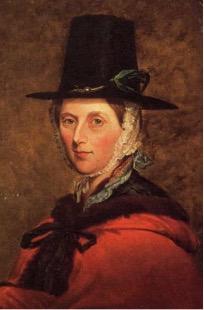
The subject of Dr Löffler’s lecture was Lady Augusta Hall (1802–1896) of Llanover House in Monmouthshire, a central figure of the Welsh national revival in the nineteenth century. Born at Llanover in 1802, Augusta was the youngest of six daughters and was very well educated and widely travelled by the time she married Benjamin Hall (1802–1867) of neighbouring Abercarn in 1823. Their marriage joined the large estates of Llanover and Abercarn, and Dr Löffler describes them as a certified “power couple”. Throughout the lecture we heard how Lady Llanover dedicated her long life to furthering the cultural and national characteristics of Wales, fuelled by her patriotism. She was an early member of Cymdeithas Cymreigyddion Y Fenni, who held a series of ten influential Eisteddfodau in Abergavenny between 1833 and 1853. Dr Löffler described these Eisteddfodau as her “instrument” for promoting the Welsh language, Welsh national consume, the triple harp as a national instrument, and the study of Welsh history.
It was fascinating to hear how Marion’s interest in Lady Llanover was first piqued about twenty years ago, when she discovered that she did not have her own dedicated entry in the Dictionary of Welsh Biography, despite being discussed at length in her husband’s profile. Naturally, Marion rectified this with a dedicated entry, which remains essential reading for understanding Lady Llanover's life and contribution to Welsh culture. Marion acknowledged the work of several scholars who produced significant historical work on Lady Llanover before her, notably the journalist Dorothy May Phillips who wrote under the pseudonym Maxwell Fraser, however she did find that many aspects of her life and work remained underexplored.
Welsh elite women, their social networks, their patronage, and their homes as sites of reinventing the nation are still under researched and fully deserve to be part of our national history.
Marion’s lecture explored Lady Llanover’s various contributions through the lens of her extensive social network, which included people of all social classes from royal personages to her working-class tenants, and extended as far as the eastern edge of the British Empire.
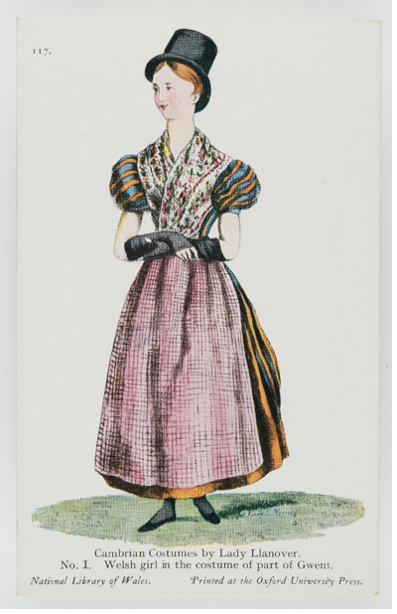
First we heard about her elite network, which included countless members of the county families of Wales and the border counties, whom she encouraged to provide prizes for the Abergavenny Eisteddfodau. Probably the most influential person in Lady Llanover’s elite circle was her elder Lady Elizabeth Coffin Greenly (1771–1839) of Titley Court in Herefordshire, who was one of the organisers of the first regional Eisteddfodau after 1815. In the 1834 Cardiff Eisteddfod Lady Coffin Greenly sponsored an essay competition, which Lady Llanover won with her illustrated essay on ‘The advantages resulting from the preservation of the Welsh language and National Costumes of Wales’, under the bardic name ‘Gwenynen Gwent’ meaning ‘Bee of Gwent’. Lady Llanover’s prize-winning essay contained a series of watercolour illustrations depicting Welsh women wearing traditional woollen and flannel costumes and black beaver hats, and is credited with laying the foundation for the Welsh national dress now seen in national celebrations. Dr Löffler provided the wider context for this, explaining how all over Europe modernisation had produced a romanticised version of the past which manifested itself in national costumes based on rural dress.
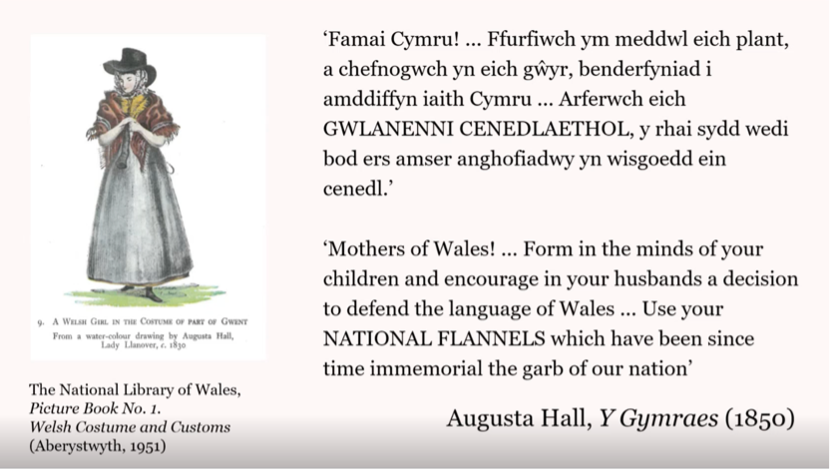
However, as demonstrated by Dr Löffler, Lady Llanover’s influence also extended to other layers of society. For example, Marion described how she “democratised” the Eisteddfod by introducing craft competitions which were accessible to illiterate members of society. She was also influential in the press and helped to establish the first Welsh-language periodical for women, Y Gymraes. In fact, we heard an excerpt from her editorial, which encouraged mothers to pass on the Welsh language to their children and wear the national costume. As well as the monetary prizes she donated or co-ordinated at the Abergavenny Eisteddfodau, she also provided musical scholarships to encourage students to learn how to play the triple harp.
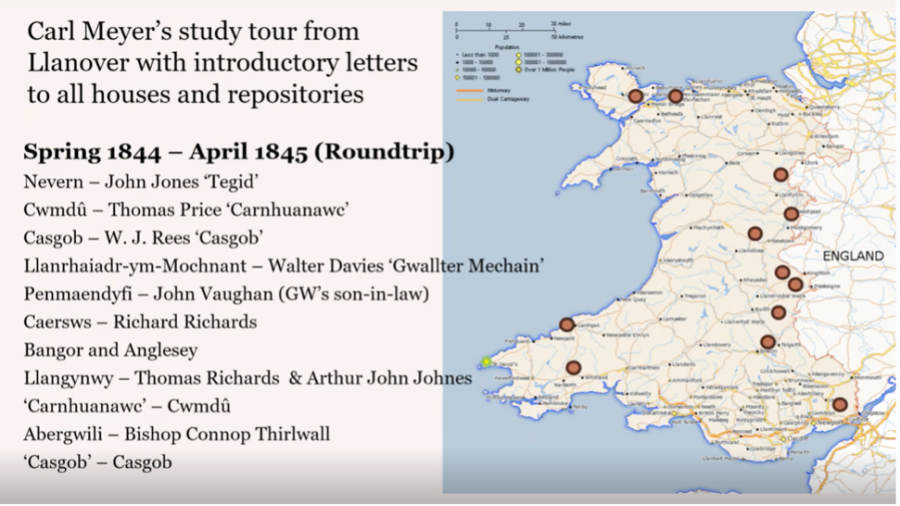
We also heard about Lady Llanover’s international connections, and how these raised the profile of Welsh culture and the Welsh language across the British Empire. In terms of family connections, her brother-in-law was the Prussian nobleman and diplomat Christian Johan von Bunsen, who was very close to the British political centre as ambassador of Prussia to Queen Victoria. He was also an ancient historian with a special interest in European languages; he helped Lady Llanover bring Welsh medieval literature and language to the world by devising, sponsoring and adjudicating literature competitions at the Abergavenny Eisteddfodau. Marion also introduced us to the German scholar Fredrich Carl Meyer, who undertook a study tour of Welsh country houses in 1844–5 in order to look at their manuscript collections, made possible thanks to Eisteddfod prize moneys and several introductions by Lady Llanover. Shortly after his study trip he was appointed German Secretary and Librarian to Prince Albert, creating a dedicated Welsh literature section in the library at Windsor Castle. On a personal note, Dr Löffler described Fredrich Carl Meyer as “something of a grandfather” to her, as the first German who spoke Welsh fluently.
We were excited to learn that Lady Llanover’s imperial connections will be the subject of Dr Löffler’s forthcoming article titled ‘Empire encounters, Welsh national culture and imperial politics: Lady and Lord Llanofer, Dwarkanath Tagore and Rungo Bapojee Gupte’, which will be published in The Welsh History Review in June 2026.
Towards the end of the presentation, we learned about the “crucial” role that Lady Llanover and her circle played in promoting ‘Cof y Genedl’, ‘the Nation’s Memory’, by creating repositories of Welsh manuscripts; establishing societies such as the Welsh Manuscript Society; supporting the work of scholars or Welsh history; and publishing their work. Marion stressed that without the Eisteddfod system that developed after 1815 and the generous prize moneys allocated to essay-writing competitions, many works on the history and music of Wales by scholars such as Angharad Llwyd, Thomas Stephens, John Emlyn Jones and Jane Williams (Ysgafell) would never have been published.
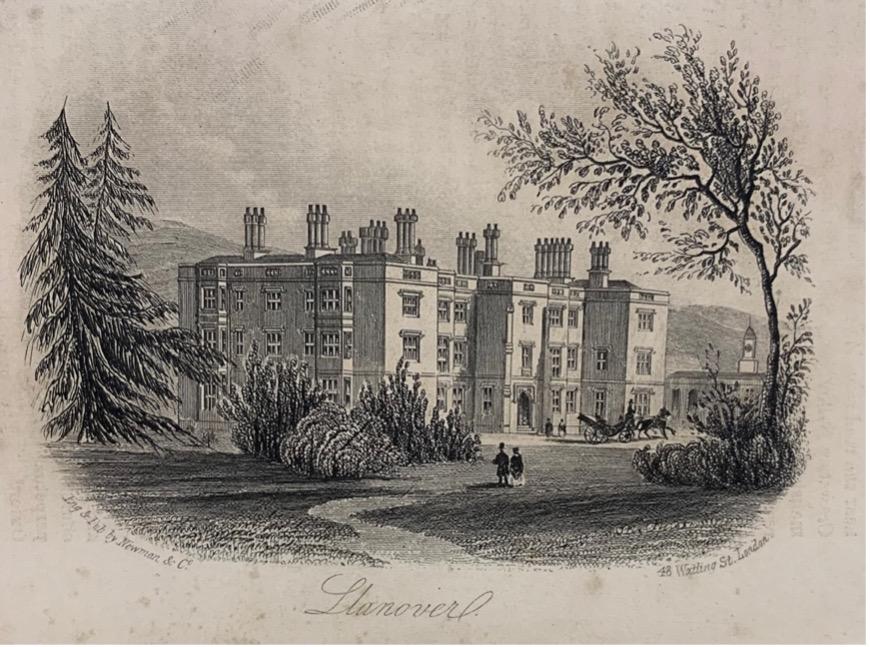
Lady Llanover’s extensive network covered different social classes and continents, but Dr Löffler emphasised that Llanover House was the central node. Under Lord and Lady Llanover, this was a meeting place for Welsh poets, authors, musicians and historians, where countless socials and theatricals took place. Marion even produced evidence to suggest that the Welsh Manuscripts Society was established at Llanover, when William Williams of Aberpergwm was staying there during the 1836 Eisteddfod. Llanover also became “a repository of the nation’s past” when Lady Llanover purchased the manuscripts of Iolo Morgannwg, preventing them from being dispersed and potentially destroyed. This was a place where Welsh culture was highly visible and tangible; where the servants wore traditional Welsh costumes and a series of court harpists – namely John Wood Jones, Thomas Gruffydd and Susannah Berrington Griffiths – were employed. Dr Löffler summarised by described Llanover as “perhaps the most important Plas in the whole of Wales” as “the site where Wales was reinvented in the nineteenth century” and “where cultural, intellectual and imperial connections with Europe and the world were formed”.
At the end of her lecture, Dr Löffler explained how Lady Llanover’s contribution to Welsh culture was gradually forgotten over the course of the twentieth century, hence the lack of dedicated entry in the Dictionary of Welsh Biography. This was partly explained by the two World Wars, but also by the dominance of social history focused on the male-working classes and the criticism of the Welsh gentry for their lack of Welsh and lack of interest in Welsh culture. Furthermore, the established historiography on Welsh gentry culture is dominated by the patriarchal experience. The pioneering work in the study of Welsh elite women was Angela John and Revel Guest’s monograph on Lady Charlotte Guest (1812–1895), contemporary and close friend of Lady Llanover, published in 1989. Since then, there have been several studies of Welsh elite women including the Davies sisters of Gregynog, Catrin of Berain, the Ladies of Llangollen, and Lady Llanover herself. In 2018, ISWE partnered with Women’s Archive Wales and Carmarthenshire Antiquarian Society to host a conference focusing on the lives of women in the history of Welsh landed estates. However, Dr Löffler ended her lecture by stressing that “Welsh elite women, their social networks, their patronage, and their homes as sites of reinventing the nation are still under researched and fully deserve to be part of our national history”.
At the end of the lecture, the audience showed their appreciation before we moved on to questions. In response to a question about what “drove” Lady Llanover, Marion shared how she believes it was patriotism, but stressed that to the Welsh gentry in this period patriotism was cultural rather than political. Another audience member asked if there was another figure who would have filled this role if Lady Llanover had never been born, and Marion came to the conclusion that there was no one, as Lady Llanover was uniquely positioned because of her free time, money, social standing, and family connections.
We would like to extend our sincere thanks to Dr Marion Löffler for her excellent lecture, and to our attendees at Bangor University and online for joining us.