

About the Centre
Bangor University's Centre for Arthurian Studies functions as a hub of international research exchange, aiming to bring together diverse expertise from across the chronological span of Arthurian legends, print and visual media, and theoretical approaches. Alumni of the MA and PhD programmes and other collaborators from across the world are associate members of the Centre. The Centre's international connections are further enhanced by the election of two Bangor scholars to prominent positions in the International Arthurian Society, a scholarly society established in 1949.
The Centre was formally constituted in 2015, to coincide with the arrival of the donation of the Flintshire Harries Arthurian collection. The launch of the Centre took place in January 2017, and included an address by Dr Aled Llion Jones outlining the history of Welsh Arthurian Studies at Bangor, an inaugural lecture by Prof. Raluca Radulescu, and a talk by Prof. P. J. C. Field. Public lectures that celebrate the collections have been given since.
From 1964 until his retirement in 2004, Professor P.J.C. Field lectured in the School of English Literature and was director of the MA in Arthurian Literature, unique in the world. His work on the fifteenth-century romance writer Sir Thomas Malory led to his publication of a revised edition of E. Vinaver’s The Works of Sir Thomas Malory in 1990, and in 2013 Prof. Field published the first full edition of Malory’s text from both the Winchester manuscript and Caxton’s first printed edition, as a result of over 50 years of scholarship. Professor Field also served as President of the International Arthurian Society (2002-2005).
Our Co-Directors are Professor Raluca Radulescu and Dr Aled Llion Jones. Professor Radulescu is currently Vice-President of the International Arthurian Society; she was previously elected President of the British branch (2015-18) and general founding editor of the Journal of the International Arthurian Society and of the Annual Bibliography of the International Arthurian Society. She has published extensively on Sir Thomas Malory and anonymous Arthurian romances, the Grail, Brut chronicles and political propaganda utilising the Arthurian legends. Her monographs are The Gentry Context for Sir Thomas Malory’s Morte Darthur (2003) and Romance and Its Contexts in Fifteenth-century England: Politics, Piety and Penitence (2013). She is co-editor, with Andrew Lynch, former President of the IAS, of the forthcoming 2-volume Cambridge History of Arthurian Literature and Culture.
Dr. Aled Llion Jones's recent monograph is concerned with the wider prophetic tradition of the Welsh middle ages, including Arthurian texts. Darogan: prophecy, lament and absent heroes in medieval Welsh literature (Cardiff: University of Wales Press, 2013). A series of subsequent articles concern various aspects of medieval Welsh and Irish prose and poetry, from studies of poetics, to temporality, translation theory and and translation reception. His Keynote Address at the 38th Harvard Celtic Colloquium, 2018, was a comparative study of medieval Irish and Welsh narrative strategies through the theoretical lens of modern physics and postmodern literary theory. He has also published translations to Welsh of modern Irish and Polish literature, and is co-author of the forthcoming Oxford Literary History of Wales, vol. 1.
What's New?

Professor publishes landmark Cambridge History of Arthurian Literature and Culture
Raluca Radulescu, Professor of medieval literature and Director of the Centre for Arthurian Studies, has co-edited a major new scholarly work, The Cambridge History of Arthurian Literature and Culture (CHALC), published by Cambridge University Press as part of its prestigious Cambridge History series.

'EUARTHURS: European Arthurs, Medieval to Modern’ Ref: 101226326 (2026-30)
EUARTHURS: European Arthurs, Medieval to Modern’ Ref: 101226326 (2026-30) is a Marie Sklodowska Curie Doctoral Network (MSCA DN) project (c. 3 million euros) led by Prof. Raluca Radulescu (Bangor University, Wales, United Kingdom), PI, with a team of Co-PIs from 6 countries: United Kingdom - Wales (Bangor University: Prof. Raluca Radulescu and Dr Aled Llion Jones); Iceland (University of Iceland, Reykjavik: Prof. Sif Rikhardsdottir); Italy (Scuola Normale Superiore di Pisa: Prof. Lino Leonardi and Prof. Fabrizio Cigni); The Netherlands (University of Amsterdam: Dr Marjolein Hogenbirk and Prof. Irene van Renswoude, and University of Utrecht: Dr Martine Meuwese); France (University of Clermont Auvergne: Prof. Sébastien Douchet). Two additional doctoral students are part of the network, funded separately by SERI (the Swiss government) at the University of Zürich and supervised by Prof. Richard Trachsler. The project is hosted by the Centre for Arthurian Studies at Bangor University, where the network Project Manager, who assists Prof. Radulescu in the network coordination is also located.

Home is Where the Legends Are
‘Home is where the legends are’ is a Centre for Arthurian Studies project funded by the Bangor University Fund, the Vice-chancellor’s initiative, which supports areas of strategic priority for the university in the 140th anniversary year of Bangor University (1884). The aims of the project are to highlight the central role played by Arthurian and Celtic Studies in the local area around Bangor University, in the foundation of the university library at the inception of the university, and in shaping scholarship, teaching and further research in these fields. The project is grounded in Bangor University’s Archives and Special Collections, including a celebration of the Flintshire Harries Arthurian collection.

Centre for Arthurian Studies: 5-year celebration and Fellowship fund-raiser
On 8 February this year, Professor P.J.C. Field will be returning to Bangor University to give a keynote lecture, 'Dating the Battle of Badon’ at the fifth anniversary of the official launch of the Centre.

Exhibition: Sir Ifor Williams and Arthurian Studies in the Bangor Archives Collections
Ph.D. student Aude Martin explores Bangor University's substantial collection of Sir Ifor William's work, beginning with two groups of letters from J. Gwenogvryn Evans and Roger S. Loomis.

Our latest Post
The much-awaited for new A24 Green Knight movie, starring Dev Patel, opened to UK audiences just recently, after a delayed release. Read our review here!

Centre for Arthurian Studies' Blog
On the Centre's Blog webpage, learn about Arthurian Studies at Bangor University, find information on conferences and symposiums, and discover our latest news, events, and articles!

Arthurian Scholarship at Bangor University
This year's new Arthurian MA students learning about our rare Arthurian books.

Arthurian Scholarship at Bangor University
Prof Aled Llion Jones in Bangor University's Archives and Special Collections presenting our Arthurian rare book collection.

Engaging with the Public
Special Collections Co-Ordinator Shan Robinson gives a tour to guests of the Centre.

Launch of the Flintshire Collection with Roger Simpson
Celebrating the founding of the Flintshire collection at Bangor University in 2015.

Launch of the Flintshire Collection with Roger Simpson
A small sample of the Arthurian books from Bangor University's Flintshire Collection.

Starting the Centre
The Centre for Arthurian Studies' launch in 2017, featuring from left to right: Shan Robinson, Sue Hodges, Prof. John Hughes, Prof. Raluca Radulescu, Emeritus Prof P.J.C. Field, and Prof Aled Llion Jones.

'Arthurian Placenames in Wales' Book launch
Launch for The Arthurian Place Names of Wales by Centre fellow Scott Lloyd.

Arthurian Scholarship at Bangor University
The Centre for Arthurian Studies regularly takes students to visit the amazing Arthurian manuscripts at Manchester University's John Rylands Library.

Arthurian Symposium 2018
A group picture of the wonderful participants of the Centre's Arthurian Symposium in 2018.

The Centre for Arthurian Studies
This reading room houses the Flintshire collection, donated to Bangor University in 2015.

Arthurian Quest 2018
An art Project from one of our Arthurian Quest participants in 2018.

Sword in the Stone
This sword in the Stone is featured in the Centre's reading room, used in one of the Centre's many Medieval fun days.

Arthurian Scholarship at Bangor University
Prof Raluca Radulescu shows students our rare Arthurian books in Bangor University's Archives and Special Collections.

Arthurian Scholarship at Bangor University
Dr. Ceridwen Lloyd-Morgan presenting at the Arthurian Symposium in 2018, hosted by Bangor University.
Arthurian Scholarship at Bangor University
Prof. Raluca Radulescu gives a lecture at the Arthurian Symposium in 2018.
Arthurian Literature
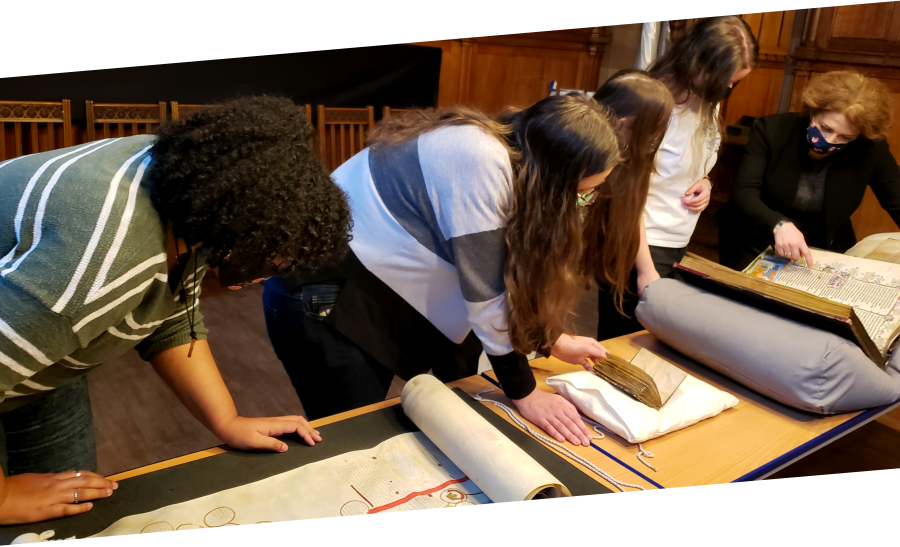
Arthurian literature at Bangor University explores insular (Britain and Ireland) and Continental medieval traditions of Arthurian writing from the inception of the legend (perhaps as early as the 6th century) to the present day. Students can engage in deep comparative study of Latin, Welsh, Irish, Breton and English/French texts, with the additional advantage of studying other linguistic traditions, if necessary in modern English translation.

Please introduce yourself.
Hi, I'm Raluca Radulescu, I'm a professor in medieval literature here at Bangor University and the Director of the Centre for Arthurian Studies, and of the Arthurian MA.
Tell us about the MA in Arthurian Studies
The MA in Arthurian studies has been running at Bangor University for over 20 years but also before that for nearly 40. It is a very international program that brings together expertise in Arthurian studies, in Celtic studies, in Welsh history and it's really grounded in the Legends and the land. Here in Bangor, we are not only based in the place where the legends originated, but we also utilize our expertise in a number of fields including in English literature, in Welsh literature, medieval to modern Welsh history, heritage, publishing. So, we're looking at the global phenomenon that the Arthurian myth has become, and we're looking at different translations in different languages from French, German, Italian, and way beyond up to the modern novel and indeed modern media.
What makes the MA so special?
The MA in Arthurian Studies at Bangor is special because it brings together not only the expertise of those who teach it, but also those who research different aspects of the legend. My own interest in the legend stems from my expertise in medieval English literature, in particular the chronical aspects, how Arthur was talked about in the medieval chronicle known as The Brut, going all the way back to the mythical founder of Britain talked about by Geoffrey of Monmouth in his Historia Regum Britanniae, Brutus, and how the Arthurian story brings together different strands of a national myth and a national story about conquest but also of civilization, of bringing courtly values to this part of the world.
I'm interested in that as well as in the work of Sir Thomas Mallory, the 15th century author who wrote during the Wars of the Roses, and how his text Le Morte d'Arthur, the death of Arthur, provides the one single long prose account of the rise and fall of the round table under the leadership of King Arthur. In other words, being the longest text in the English language from the Middle Ages that influences generations of writers and readers and is owned and enjoyed for centuries up to the 21st. So, my own expertise is in the work of Sir Thomas Mallory the 15th century author who brought together different strands of the Arthurian story into one long prose account in the English language which has become, to the present day, one of the most popular and enduring versions of the Arthurian myth.
In particular I can work here at Bangor University and the students I teach can use the collections, including this example of the last early modern printed edition of Le Morte d'Arthur from 1634 printed by William Stansby in London. It is an example of a late, one might say, edition of the 15th century text, so in the 17th century we still have the gothic type, the black letter alongside utilizing a woodcut introduced first by Wynkyn de Worde, William Caxton’s apprentice for the printing of Le Morte d'Arthur.
Alongside that I'm really interested in the publishing history of Arthurian texts, be they of Mallory’s Le Morte d'Arthur, or other ones including for example stories or antiquarian interest in the historicity of Arthur, so the reprinting or the printing and editions of Gildas and Nennius in the early 16th century, we have an example here from the Flintshire Harries Collection, or indeed beautiful examples of the golden age of illustration and of publishing history Le Morte d'Arthur reprinted in the early 20th Century with its original wood cuts from Wynkyn de Worde but in in modern type. Or indeed exploring how in the 18th century Charles Bertram not only printed Gildas and Nennius in his efforts to inscribe himself in the history of Arthurian studies as an antiquarian, but he also forged a text about King Arthur and put his name into the book as the editor of these texts.
There are several special things about studying a Bangor for an Arthurian MA, and definitely one that comes to mind is being part of the community of scholars who enjoy being in the locations where the Arthurian myth came into being, where it was written down, and working alongside those who specialize whether it is Celtic archaeology, Celtic legend and myth, Welsh medieval history or indeed the publishing history of these books. At Bangor University we hold one of the most important collections of Arthurian books in the UK and in Europe and we're very lucky to have this collection for our use on the MA and with our PhD students.
In particular I'd like to highlight the fact that we constantly work with the community, we get donations, and we organize a number of events that involve our students in contact with the latest research in the field. We have events that our students get involved in whether they present their research where they're part of an international reading group as we are at the moment, whether they help with various exhibitions or community engagement events. There are plenty of opportunities to develop not only academic skills, perhaps publish in the Journal of the International Arthurian Society, or indeed to develop skills in relation to a future profession, a future job be it in heritage, in the media, or something else that is related.
In other words what we do at Bangor university we provide a very full and complex education that prepares you for the world the world of today involves not just knowing how to read and analyse these texts and how to enjoy how myth goes on and inspires, it is also about providing this enduring legacy as a fruitful avenue for further reading and further research whether it is by the young in children's fictions or whether it is by the general public be it in film or in journalism the Arthurian MA at Bangor University provides all of these opportunities and much more.
Latest projects, posts, articles, interviews, and events featuring our members and all things Arthurian.


Bangor-Rochester Reading Group
The Centre for Arthurian Studies and the Rossell Hope Robbins Library have come together to establish a graduate reading group, covering texts from all walks of Arthuriana.

Currently Reading Heinrich von dem Türlin's Diu Crône, or "The Crown"
Diu Crône is a 13th-century romance that tells the story of the grail quest but differs from previous retellings. In this story, Gawain is the knight who achieves the grail after a series of remarkable adventures.
Lectures from the 2020 - 2021 series organised by the Centre for Arthurian Studies covering topics pertaining to Arthurian and Celtic traditions, with a focus on the relevance of legends and their retellings both in and outside their original Welsh contexts. The crossing of borders (geographically, linguistically, and in time periods) is key to our understanding of the impact of Arthurian stories.


Members of the Centre
Current Members


External Board
Emeritus Director of the Rossel Hope Robbins Library and the Koller-Collins Graduate English Center, University of Rochester
Dr. Roger Simpson (1938-2022)
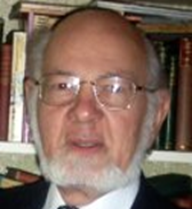
It is with great sadness that we report the recent death of Dr. Roger Simpson, a member of the British Branch of the International Arthurian Society, but a great supporter and friend of the North American Branch and a frequent contributor to Arthuriana as an author and as a submissions and book reviewer. Roger had a truly amazing academic career. After earning a BA in English Language and Literature in 1960 from Wadham College, Oxford, he completed a Diploma in Education at Oxford two years later. From 1962-1963, he was Assistant English Master at Verdin Grammar School in England. From 1963-1965, he was Senior English Master at Old Kampala Senior Secondary School in Uganda. From 1965-1966, he returned to England and served as Assistant English Master at Aylesbury Girls High School. From 1966-1968, he was Senior English Master at Momenshahi Cadet College in East Pakistan (now Bangladesh). From 1969-1982, he was Senior Lecturer and Head of English at Gulf Polytechnic in Bahrain. He returned to England in 1982 to take up a position at the University of East Anglia in Norwich where he taught and remained until 2003. In 1988, he completed his doctorate at the University of East Anglia with a thesis on The Arthurian Revival and Tennyson, 1800-1849. In 1998, he was a visiting scholar at the National Museum of Ethnography in Osaka, Japan. Roger authored two important Arthurian monographs: Camelot Regained: The Arthurian Revival and Tennyson, 1800-1849 (1990) and Radio Camelot: Arthurian Legends on the BBC, 1922-2005 (2008). His other publications include dozens of essays and reviews on multiple aspects of Arthuriana. Roger was a scholar’s scholar who took immense joy in the painstaking work of unearthing forgotten Arthurian works and authors. And he was able to present his research in a comprehensive and compelling way and to infect others with his enthusiasm for his discoveries. And, as his two books and many essays attest, he was interested in, and made contributions to, the study of Arthuriana in both “high” and popular culture. But, whether responding to questions at a conference from an established colleague or from beginning graduate students, Roger was always the model of earnestness, grace and courtesy. He was the gentlest of gentlemen. To those who knew him, he was a convivial colleague, a charming host, and the most generous of scholars. Like Chaucer’s Clerk, gladly did he learn and gladly teach. Survivors include his wife, Paddy, and their son, Dr St John Simpson, Assistant Keeper for Iran, Central Asia and Arabia at the British Museum.
Alan Lupack, Director Emeritus, The Robbins Library, University of Rochester
Barbara Tepa Lupack, Rochester, New York
Kevin J. Harty, Professor of English, La Salle University
Associate Members
University of Wisconsin, Madison
East Tennessee State University
Acadia University
Sam Houston State University
De Montfort University
Keio University
Independent Scholar
Independent Scholar
Boydell & Brewer
*Fill in
Halmstad University, Sweden, Visiting Research Fellow 2018
Fellows
Brno University
Bangor Alumna and Bristol University, Fellow of the Stephen Colclough Centre for the History and Cultures of the Book
Halmstad University, Sweden, Visiting Research Fellow 2018
University Research Fellow 2018
Arthurian Literature Teaching Staff
Our Growing Research Community: Postgraduate, Alumni, Early Career Fellows and Associate Members of the Centre
3rd year PhD, in co-tutelle Bangor University-Univ. of Lorraine
2nd year PhD, Bangor University
PhD candidate - post-viva corrections stage
PhD candidate - post-viva corrections stage
Bangor PhD 2014, Lecturer at the University of Latvia
MA alumnus 2021
MA alumnus 2021
MA alumna 2021
Jessika Brandon
Merlynn Spencer
Partners


History of the Collections
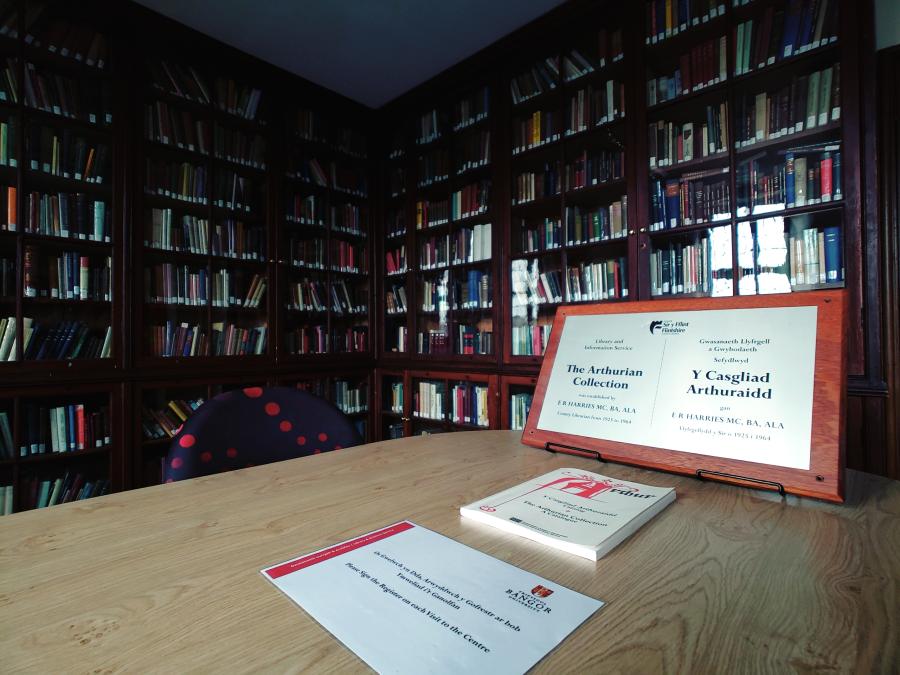
Bangor University Library's Arthurian and Celtic studies collections have their inception at the time the University Library was founded in 1884, when donations were made by local supporters as well as by scholars and members of staff.
Recently Flintshire County Libraries has kindly donated its Arthurian Collection to Bangor University; where it now is being curated, preserved and managed by the Library and Archives Service. The collection, which is of major interest to scholars and general readers, was originally donated to Flintshire County Libraries in 1952 by E. R. Harries, a former librarian of the county. Flintshire and Clwyd library services, then added further stock. It now contains over 2,000 items of interest to scholars and general readers alike. This collection enhances Bangor's existing collection, in particular through the addition of further rare books. Scholars who would have previously had to travel to both Mold and Bangor will now find these resources in the same location.
The arrival of the Flintshire Harries Arthurian collection, a predominantly, though not exclusively English-language collection of post-medieval rare books and criticism, predominantly on English-language legends, was celebrated with a launch in April 2015, including a public lecture given by the late Dr Roger Simpson and an exhibition of rare books from the Bangor and Flintshire Harries collections, curated by Prof. Raluca Radulescu and Shan Robinson.
Home is Where the Legends Are
‘Home is where the legends are’ is a Centre for Arthurian Studies project funded by the Bangor University Fund, the Vice-chancellor’s initiative, which supports areas of strategic priority for the university in the 140th anniversary year of Bangor University (1884). The aims of the project are to highlight the central role played by Arthurian and Celtic Studies in the local area around Bangor University, in the foundation of the university library at the inception of the university, and in shaping scholarship, teaching and further research in these fields. The project is grounded in Bangor University’s Archives and Special Collections, including a celebration of the Flintshire Harries Arthurian collection. This online exhibit is complemented by the Centre’s 2024 Arthurian Lecture series, organised under the aegis of the 140th anniversary of Bangor University, and an educational programme for primary schools in the local area for the New Creative Curriculum in Wales, conducted by Prof. Radulescu with Gillian Brownson, local storyteller and performance artist, and Maria Hayes, fine artist.


Visit us with the P.J.C. Field Fellowship!
The Centre for Arthurian Studies at Bangor University has set up the P.J.C. Field Visiting Fellowship fund in Arthurian Studies. Through donations, the endowed Fellowship is intended to provide a period of research at the Centre for Arthurian Studies in association with the Library and Special Collections at Bangor University for a scholar whose research is closely aligned with the collections and research expertise in the Centre. It is open to qualified applicants in all fields of Arthurian studies: in the past, visiting fellows have worked on medieval and post-medieval Arthurian studies, rare books in the collections, and connections between our collections and those in other repository libraries.
The recipient will take up residence in Bangor or its immediate neighbourhood and make use of the collections for a period ranging from one week to three months. They will be responsible for living expenses but, depending on need and available funds, the fellowship can cover partial or full travel expenses. The fellow will engage in the academic life of the Centre and the University, and toward the end of the residency they will usually give a talk arising from the research undertaken while on the fellowship.
To make your donation click the link below.
Thank you for supporting the Centre for Arthurian Studies.
Get Involved with the Centre for Arthurian Studies
There are many ways to get involved with the Centre for Arthurian Studies at Bangor University!
We recognise that many individuals and organisations external to the Centre for Arthurian Studies (CAS) share an interest in progressing our intellectual aims and aspirations. Partnership and collaboration with these colleagues and stakeholders is fundamental to our development. We, therefore, offer Associate Membership and Fellowship status as forms of affiliation for both internal and external individuals and organisations who actively support and contribute towards our long-term objectives. We also offer Fellowships to support relevant shorter-term projects.
Associate Membership and Fellowships are offered as means of enhancing our academic reach and collaborative capacity, both within Bangor University and, importantly, through engagement with a network of external partners in other research organisations and sectors (such as cultural heritage and archives). Our Associates and Fellows will play an important role in helping us to embed the reach of the Centre throughout Wales, and assist in demonstrating the international relevance of our work.
Renewable annually, this status offers longer-term affiliation to the Centre. Associate membership is available for individuals and organisations. Individual associate members enjoy library card and email privileges, for projects which benefit the collections and research culture of the Centre. Associate membership is typically bestowed on scholars who spend longer periods at the Centre (e.g., a sabbatical) or local independent scholars. The status is not usually granted in the absence of evidence of scholarly engagement. Individual Associate Members will give a scholarly talk from their research project during term time as part of the Centre's research seminar series, and thus contribute to and enhance the research culture of the Centre.
Short-term fellowships, lasting from a fortnight to a semester, bring the same rights as those of Associate Member, provided access to a library card and email are necessary. Fellowships are intended to assist with discrete research projects related to the Centre's collections. Holders of Fellowships will write a blog or short post on the topic of the research project, to be posted on the Centre’s website, and they will participate, if appropriate, in the activities of the Centre.
Individuals and organisations seeking to apply for Associate status must be able to demonstrate an active contribution towards the fulfilment of CAS’s aims and aspirations:
For individuals this can be in the form of research activity; peer-reviewed publications; HE-level teaching; postgraduate supervision; collection knowledge; and/or curatorial expertise in areas relating to CAS’s intellectual identity.*
For organisations, societies and groups this can be in the form of organisational priorities; research activity; and/or curatorial expertise in areas relating to CAS’s identity. Such organisations may include archives; cultural heritage organisations; research centres and other academic entities; history/heritage societies and community groups.
* All doctoral and postdoctoral researchers, honorary research fellows, visiting professors and professional archivists appointed to work on projects originating from CAS are granted automatic membership.
Donations (in the form of financial support towards the funding of visiting fellowships for independent scholars or postgraduate students, or the purchase of scholarly books) are warmly invited from supporters of the Centre.
Contributions will enable Arthurian scholarship to thrive now and in the future, and enrich this unique resource for Arthurian studies in the world.
Please contact Professor RalucaRadulescu to discuss your gift:
Email: r.radulescu@bangor.ac.uk
Phone: +44 (0) 1248 38 2110
Post: Centre for Arthurian Studies, Bangor University, College Road, Bangor, LL57 2DG
If you are interested in our collections, you can arrange a visit by prior appointment by contacting us directly.
arthur@bangor.ac.uk