
Health and Care Economics Cymru is a partnership between the Centre for Health Economics and Medicines Evaluation (CHEME) at Bangor University and the Swansea Centre of Health Economics (SCHE) at Swansea University.

| 
|
Health and Care Economics Cymru (HCEC) is supported by Health and Care Research Wales funding, which is funded by Welsh Government.

| 
|
As a centre of excellence in health economics, we have a track record of supporting high quality health and care research in Wales and beyond.
See our explainer video:

When health and care resources are limited, we need to find out which treatments, interventions and services offer the best value for money. Our Health and Care Economics Cymru team explores the costs and benefits of the different uses of these resources. We provide the best evidence possible and help decision-makers to make tough choices about how to allocate limited health and social care provision. We work towards creating a positive impact on the health, well-being and prosperity of the people in Wales and beyond, now and in the future.
With emphasis on collaboration and partnership we provide expertise as described in our infographic:
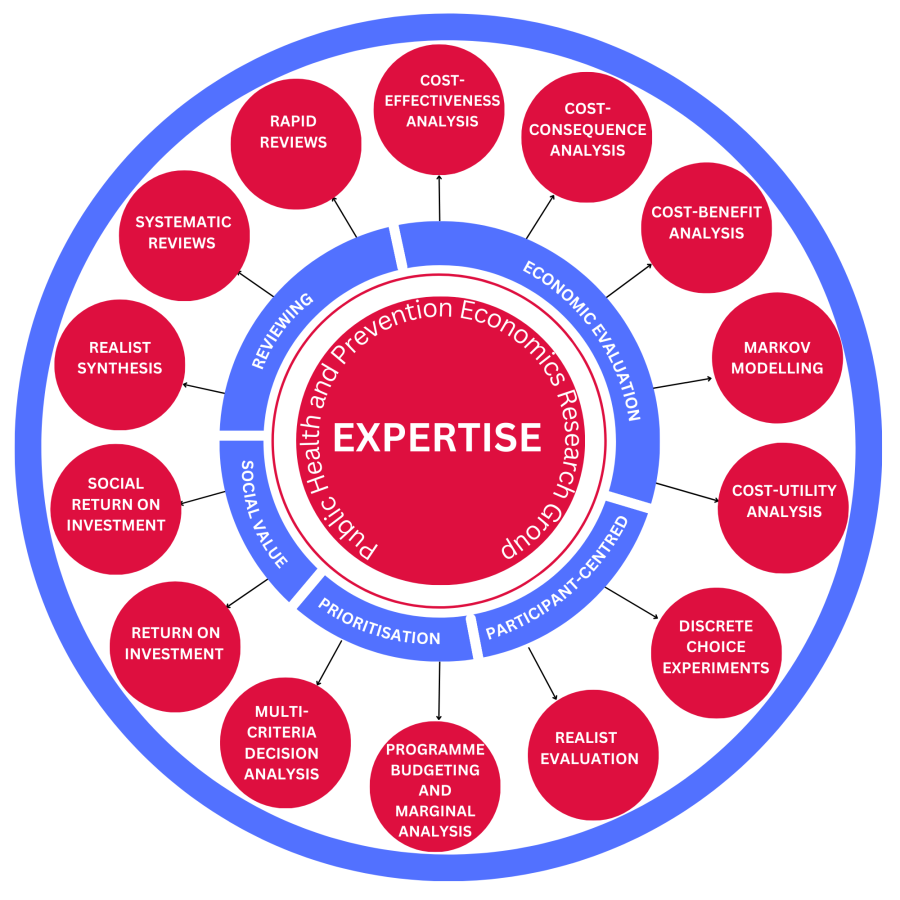
Image description: This is a spider graph detailing the methods we use. The categories form a concentric ring in blue, and they are: Social Value, Reviewing, Economic Evaluation, Participant-Centred and Prioritisation. The methods are displayed in red circles attached to each category. For Social Value they are social return on investment and return on investment. The methods for Reviewing are realist synthesis, systematic reviews and rapid reviews. Our economic evaluation methods are cost-effectiveness analysis, cost-consequence analysis, cost benefit analysis, Markov Modelling and cost-utility analysis. Participant-centred methods are realist evaluation and discrete choice experiments. Prioritisation methods are multi-criterial decision analysis and programme budgeting and marginal analysis.
- Other Health and Care Research Wales groups such as the Centre for Vision Services Research and National Centre for Mental Health.
- Clinical trials units and other researchers across Wales, the UK, and internationally supporting clinical trials or real-world studies that, in addition to clinical benefit, also need to demonstrate whether new interventions or treatments are cost-effective.
- Health and care organisations such as NHS Trusts and Health Boards, local authorities and other care providers undertaking real-world evaluations using routine data to investigate whether existing local services or interventions provide good value for money.
- Local authorities and charities exploring the social value of investment in new services and interventions.
Building capacity and capability is a key role of Health and Care Economics Cymru.
We co-ordinate the Welsh Health Economists’ Group (WHEG), connecting a community of health economics expertise across Wales. Our annual meetings provide a valuable opportunity for Health and Care Economics Cymru-funded PhD students and researchers to collaborate with public sector health economists, and colleagues across health and social care organisations to discuss current activities and plans with regard to research, teaching and policy support, increasing awareness of health economics and fostering access to a community of expertise.
To find out more about WHEG and our annual meetings, please contact Ann Lawton, Health and Care Economics Cymru Administrator, a.b.lawton@bangor.ac.uk
In response to the Wellbeing of Future Generations Act and demands from third sector and local government to help them demonstrate social value, we established the Social Value Hub. As an organisational member of Social Value UK, the Social Value Hub provides organisations with a framework for measuring change in ways that are relevant to their stakeholders.
Public involvement in health and care economics research
The Centre for Health Economics and Medicines Evaluation (CHEME) at Bangor University, the Swansea Centre for Health Economics at Swansea University (SCHE), as part of Health and Care Economics Cymru (HCEC), invite members of the public to support health and care economics research taking place across Wales.
Public and Patient Involvement and Engagement (PPIE) is central to health economics as a discipline as meaningful engagement helps ensure that research questions, outcome measures, and value judgements reflect what matters to patients, carers, and communities, rather than relying solely on technical or institutional perspectives. This improves the relevance, legitimacy, and acceptability of economic evaluations, and supports better-informed commissioning and policy decisions that can lead to improved outcomes. PPIE is now firmly embedded within good practice in health economics, reflected in international standards such as the CHEERs reporting guidelines, which emphasise transparency, relevance, and stakeholder engagement in economic evaluation.
We are developing a group of public representatives to advise and comment on a range of research activities. The group provides a way for us to hear directly from people with lived experience to include a wide range of views in how research is shaped (research ideas and grant capture), delivered, and shared. Equity, diversity and inclusion (EDI) should be embedded alongside PPIE to ensure that involvement reflects the full range of lived experience, reduces the risk of systematic exclusion, and supports evidence and decisions that are fair, representative and responsive to unequal needs and outcomes.
Vision and principles: PPIE and EDI
These principles guide how research is:
conceived and designed
conducted and analysed
interpreted and disseminated
Research is developed in partnership with communities, ensuring diverse voices help shape evidence that is relevant, inclusive, and useful.
Our approach
We focus on:
creating inclusive research environments
embedding PPIE and EDI values across all activities, including across all our capacity building plans
reflecting public input clearly in research decisions and outputs
This approach aligns with the Welsh policy context and supports co-production from the earliest stages of research through to impact. Public involvement strengthens the relevance, quality, and impact of our research and supports meaningful change in policy and practice.
Why public engagement matters
HCEC use the definition of public engagement as research carried out with or by members of the public, rather than research done to, about, or for them without meaningful input.
Public involvement helps strengthen research by:
shaping research questions that matter to people and communities
improving study design, accessibility, and acceptability
supporting relevant analysis, interpretation, and dissemination
increasing the likelihood that findings influence policy and practice
Public and patient voices are sought across the full research life-cycle, from early development through to sharing findings. Seldom heard voices will be included through proactive and inclusive engagement approaches, working in partnership with trusted community organisations and support networks to reach people who are often under-represented in research. This will include using accessible and flexible involvement methods (for example, easy-read materials, alternative communication formats, and varied modes of participation), removing practical barriers such as transport, timing and digital access, and providing appropriate support and reimbursement. Engagement will be culturally sensitive and responsive to individual needs, ensuring that people are supported to participate safely and meaningfully rather than expected to fit standard research processes.
What does engagement look like?
Public representatives support the design of studies and the development of reports and outputs. The group aims to meet around three times a year, with additional flexible opportunities to contribute to specific projects.
Involvement is designed to be adaptable. Contributions may take place:
online or by telephone
through attending meetings or workshops
by commenting on draft documents via email
in community settings, for example, local schools.
There is no fixed commitment. People are invited to contribute when they are able and interested.
All public representatives are paid for their time with a ‘thank you’ voucher.
Who can take part?
No previous research experience is required. We welcome expressions of interest from anyone aged 18 or over who lives in Wales. This can include members of the public with an interest in health economics, people accessing health and care services or unpaid carers.
How to get involved
To express interest, please contact: Public Involvement and Engagement Strategic Lead: Dr Ceryl Teleri Davies: ceryl.davies@bangor.ac.uk
Examples of public engagement in practice
Care Leavers Engagement with Services
This two-year Health and Care Research Wales funded project explored the barriers and enablers to engagement with professional support services experienced by care leavers. Care-leavers and multi-agency practitioners from four participating local authorities were involved at the conception of, and throughout the study, as part of the project advisory group (PAG). From the inception of the project fourteen young adults who were care -leavers or care-experienced were involved in developing the research ideas and questions. These conversations took place online during lockdown, which enabled greater accessibility to participation. The two PAGs consisting of the four local authority leads and four care -experienced young adults met every one to three months to discuss the project updates and give their feedback on project materials including semi structured interviews and surveys and the development of a toolkit for care leavers.
A project podcast was co-produced with care-leavers and practitioners working with care-leavers: ‘Symud i fyny /Moving up’. This is publicly available and free of charge (https://www.spreaker.com/podcast/moving-up-symud-i-fyny--5971874). This featured four episodes:
Enablers, Barriers, and outcomes for young adults.
Care Leavers experiences of working with services.
'Researching with and not for - shaping research through co-production'.
Live from the symposium – end of study event.
We held a workshop session with Social Care Wales participants – this was well received and resulted in a blog by the evidence community manager with links to the toolkit slides and podcast.
At the end of the study, we held a symposium (11th September 2024, at Bangor University) as a knowledge exchange event with interested public, care-leavers, academics, and practitioners. This event was attended by 39 people. We presented the study findings to a range of stakeholders including policy leads across Health and Social Care in Wales, senior members of participating local authorities, young adults who are care leavers and multi-agency practitioners.
The final podcast was recorded at the event with key discussions reflecting on the outputs, outcomes and impacts of the research, the PAGs experience of being involved in research and their recommendations for future practice, policy, and research. Attendees at the event were given copies of the study outputs – with hard copies of the toolkit in Welsh and English.


A focus on PPIE and EDI of research was a ‘golden thread’ from inception to the final stages of the research dissemination and impact.
All-Wales Diabetes Prevention Programme Process Evaluation Protocol and Data Collection Development and Research Ethics
The All Wales Diabetes Prevention Programme (AWDPP) was designed for people at risk of developing type 2 diabetes. Public Health Wales wanted to find out how well AWDPP was implemented and what lessons could be learned for future roll-out.
Two PPIE members of the Formative Process and Value-based evaluation of the AWDPP were involved in this piece of research. The PPIE members were part of the evaluation steering group and an integral part of the evaluation team from the funding application and later as part of the protocol and data collection tool development. The representatives attended meetings and contributed to the decision-making process.
They made a difference. Their expertise regarding diabetes and experience of the patient pathway was essential in terms of developing materials and procedures that are acceptable and accessible. Their input supported the successful delivery of the evaluation.
The final report is available at: phw.nhs.wales/services-and-teams/primary-care-division/all-wales-diabetes-prevention-programme/formative-process-and-value-based-evaluation-of-the-wave-1-roll-out-of-the-all-wales-diabetes-prevention-programme/
Further information
Health and Care Research Wales
Health and Care Research Wales has a mission to support and develop excellent research which has a positive impact on the health, wellbeing and prosperity of the people in Wales. Health and Care Research Wales believe that public involvement makes research more relevant, more reliable and more likely to change practice. More information: https://healthandcareresearchwales.org/researchers-support-and-guidance-researchers-develop-research-idea/involving-public-your-research
National Institute for Health and Care Research
An integral part of research funded by the National Institute for Health and Care Research (NIHR) is to ensure that patients, carers, service users and the public have the opportunity to shape and influence the relevance, quality and impact of health and care research.
One of NIHR's strategic commitments for public partnerships is to strengthen capacity and capability. NIHR is committed to providing guidance and training on PPI for researchers. More information: https://www.nihr.ac.uk/ and see also the NIHR Research Inclusion Strategy 2022-2027 which sets out the Equality, Diversity and Inclusion (EDI) strategy to overcoming inequalities.
PIRIT tool
The Public Involvement in Research Impact Toolkit (PIRIT) helps researchers working with the public to plan meaningful involvement in research alongside helping to track and demonstrate the difference it makes.
The PIRIT Planning Tool is a checklist of potential public involvement related activities and relevant standards.
The PIRIT Tracking tool is a simple spreadsheet to record when and how the public contributed, what changed, why it matters, and the related standards.
Further information and access to the tool can be found here: https://www.cardiff.ac.uk/marie-curie-research-centre/patient-and-public-involvement/public-involvement-in-research-impact-toolkit-pirit
Our position
Health and Care Economics Cymru (HCEC) recognises social care economics as a distinct and under-developed area of economic research that is essential to improving outcomes, equity, and value for money across health and social care systems in Wales and the wider UK.
Social care plays a central role in supporting individuals, families, and communities across the life course. Yet, compared with healthcare, social care has lacked robust economic frameworks to capture its outcomes, quality, and longer-term system value. HCEC is committed to addressing this gap.
What we mean by social care economics
Social care economics applies economic theory and methods to understand, measure, and value social care services and interventions. This includes:
Defining what social care is and who it supports
Examining the relationship between social care and healthcare
Understanding how social care is financed and delivered
Assessing what happens when social care is unavailable or of poor quality
Estimating the economic value of providing – or failing to provide – effective social care
A core aim is the development of capability-based and outcome-focused measures that better reflect the lived realities of people who use social care, rather than relying solely on health-centric metrics.
Why this matters
Limited economic evidence in social care limits the ability of decision-makers to:
Invest confidently in prevention and early intervention
Compare social care interventions fairly with health services
Demonstrate value beyond short-term cost containment
Understand system-wide impacts on families, communities, and public services
Without strong social care economic evidence there is a continued risk of under-investment, reactive spending, and widening inequalities.
Our strategic approach
HCEC is developing social care economics as a priority area through:
Building parity with health economics, recognising social care as an equal partner in integrated systems
Strengthening interdisciplinary working, drawing on social work, public health, and wider economic disciplines
Advancing theory and methods, including capability approaches and cost-consequence analysis
Improving data quality and access, particularly across local authority and community settings
Supporting practical research infrastructure, including publication routes and researcher development
This work aligns with emerging UK-wide activity, including engagement with the Social Care Economics Network (SCENE), which promotes shared learning and methodological innovation across the sector.
Our commitment
Over the next five years, HCEC will actively develop its leadership and capacity in social care economics, with a particular focus on Wales. We aim to position social care economics as a credible, policy-relevant, and methodologically robust field that strengthens evidence-based decision-making and supports sustainable, preventative systems of care.
Social care economics is not an optional add-on to health economics. It is fundamental to understanding how public systems work – and how they can work better. HCEC has been committed to this since its inception in 2020. This reinvigorated position statement sets out our plans to ensure HCEC becomes a centre of excellence for applied care economics by 2030.
HCEC co-directors
Professor Rhiannon Tudor Edwards r.t.edwards@bangor.ac.uk 
Centre for Health Economics and Medicines Evaluation (CHEME) at Bangor University. | Professor Deb Fitzsimmons d.fitzsimmons@swansea.ac.uk 
Swansea Centre of Health Economics (SCHE) at Swansea University. |
See our 2025-26 Annual Report to read about our key achievements over the past year.