

Find the right Environmental Science course for you
Real-world teaching

I don't have many regrets, but not studying at Bangor is one of them.

[0:04]
And I'm incredibly lucky that very early in life I realised that I had this one thing that could always make me feel better.
[0:08]
Didn't matter how low I was plunging, that I had somewhere that I could take myself, where I could reset,
[0:16]
where I could remind myself of where I come from and what is special to me and the things I'm passionate about.
[0:22]
And it doesn't matter if it's up in the mountain or in a in a lake or in the sea.
[0:28]
Those are the things that just reset me.
[0:32]
And so I would say that, you know, you see yourself getting getting down, take advantage of all of the absolute wonders that we have here.
[0:40]
The people, you know, in the nation will travel hundreds of miles to come and see.
[0:45]
You have them right on your doorstep. You might only be here for three years or four years.
[0:49]
Take take advantage of them because it is so, so special.
[0:55]
And, you know, there is nothing that can compare to being up on the Glyderau or the, you know, the Carneddau as the sun is just starting to rise.
[1:04]
Standing on top of Tryfan and looking at all those mountains and just knowing that this right now is
[1:10]
your home and your place - embrace it. You've all made the best decision of your lives in coming here.
[1:15]
And I just want you all to make the most of it, treasure it, use it as best as you possibly can, you know, on your doorstep.
[1:22]
You have natural wonders that almost nobody else at university in this nation has.
[1:26]
So please, please use them to their full extent. And I promise I'll be back and see you sometime soon while you're here.

[0:03] So, so excited! It's so great to meet Steve! It's just such a great opportunity, to even see the
[0:09] Menai Strait in a different way as well.
[0:12] One of the reasons why I chose Bangor initially, was to be in such an area as this
[0:16] There's no better way to spend the afternoon really!
[0:23] We're heading out into the Menai Strait and off to Puffin Island with a group of students of the natural sciences.
[0:28] To get a flavour of the very finest of this area has to offer.
[0:47] Well, so far we've seen kind of all the very best of the wildlife from this part of the world, particularly when it comes to the birds.
[0:53] The ledges are thick, almost every single centimetre is covered with guillemots, a gull...
[0:59] and we've seen gannets and of course puffins as well.
[01:02] I guess this is why I decided to build a relationship with Bangor.
[01:06] What you can see right here. You know, any institution can invest in its infrastructure.
[01:11] Any institution can get bigger buildings or get more teaching.
[01:14] But there's no amount of investing that can get this.
[01:18] Having this on your doorstep is why Bangor is the best place to study natural sciences in the nation.
[01:30] It is fantastic. You know, obviously not just the company with having Steve there, it's seeing the wildlife that we saw the kittiwakes
[01:37] there cormorants the seals and that sort of stuff. Absolutely phenomenal, like once in a lifetime.
[01:41] Steve is such a genuine lovely guy. Yes, absolutely amazing. There's no better place to be.
[01:46] It's been a pretty amazing afternoon. I feel a little bit buffeted and and chilled.
[01:51] But to be able to head out from you know, you can see the University from here.
[01:56] You can see the halls of residence from here. To be a student here and think that you could finish studying,
[02:01] come down and get on a paddleboard or a kayak and head out into the Menai Strait and have this is your way of relieving exam stress.
[02:08] I mean, that just absolutely blows my mind.

Honorary Graduate Sir David Attenborough
“Bangor University has a superb reputation in the study of environmental science. The world needs people skilled in the expertise needed to play a crucial part in solving the world’s problems.”
Watch - Geography and Environmental Science Field Course in Snowdonia
Following in the footsteps of Charles Darwin, Environmental Sciences and Geography students at Bangor University visit Cwm Idwal, in Snowdonia, to discover the natural process that led to Snowdonia being created.

Video transcript: Field Course in Cwm Idwal - Making Snowdonia
Environmental Sciences and Geography at Bangor University: Discovering Snowdonia's Glacial Past
Exploring Cwm Idwal: A Natural Laboratory
We come out here today, particularly to Cwm Idwal, to learn about the area's glacial history. It's a fantastic example of glaciation in North Wales; in fact, it's one of the best examples in the UK. We're following in the footsteps of Charles Darwin, who came here in the 1800s and really announced that glaciation had occurred here. We bring our students out to give them an experience of what it's like to do fieldwork in North Wales and how they can read and interpret the landscape.
Hands-on Fieldwork and Landscape Interpretation
Today's task involves getting students to come out and actually map the features they see and then think about how that feeds into how glaciation happened in this area. We're having a fantastic day today: good weather and lots of happy students. We're only 20 minutes away from our school department, so it's easy to pop out and pop back within the day and enjoy that fieldwork experience.
Studying Geomorphological Features
Today, we are at Cwm Idwal with Lynda Yorke (Lecturer) in the lovely Welsh mountains, studying geomorphological features caused by the last glacial period. We're looking at glacial movements and the terrain that's left behind. This is quite an informative session; we're learning about the different features, rock formations, and things like that.
Varied Assignments and Learning Methods
Basically, the task is that we're going to put all of that stuff together, and at the end, we're going to make a geomorphological map. On each day, we were given a different assignment. On Monday, we've got an essay to write up on it. On Tuesday, I've just got a written piece that I've done then and there. Today, it's all going to be mapping, you drawing it out, so all different elements come into the research and observation lesson methods.
The Power of Experiential Learning
It's amazing, especially as you learn more about how these things got here and the different features. You can almost put a picture together of how he saw it and dawned on the ideas he didn't face. It's been really fun to actually interact with the landscape rather than just sitting there and learning about it. It's a completely different perspective, and I think it's a lot easier to understand when you can go there and actually see it for yourself rather than having to imagine it from a picture or textbook.
A Magical Location for Study
It's been absolutely awesome. Yes, it's incredible. I'm from a very beautiful place and was quite sad to leave it. I can't imagine a better place to go. We've got all of this on our doorsteps, and you can't really put yourself in a better place for this degree. It's just magical.
"The School runs fieldtrips throughout the academic year, and this is a great way to be able to learn about conservation and ecology in the natural environment."
Excellent Facilities

Our top facilities will bring what you learn on your degree to life
As part of your degree, you may make use of some of our excellent facilities, which include:
- our own natural history museum
- botanic garden
- wood library
- freshwater and marine aquaria
- dedicated reptile facilities including venomous snake collection
- Europe’s largest underground soil laboratory
- aviaries
- an ocean-going research vessel
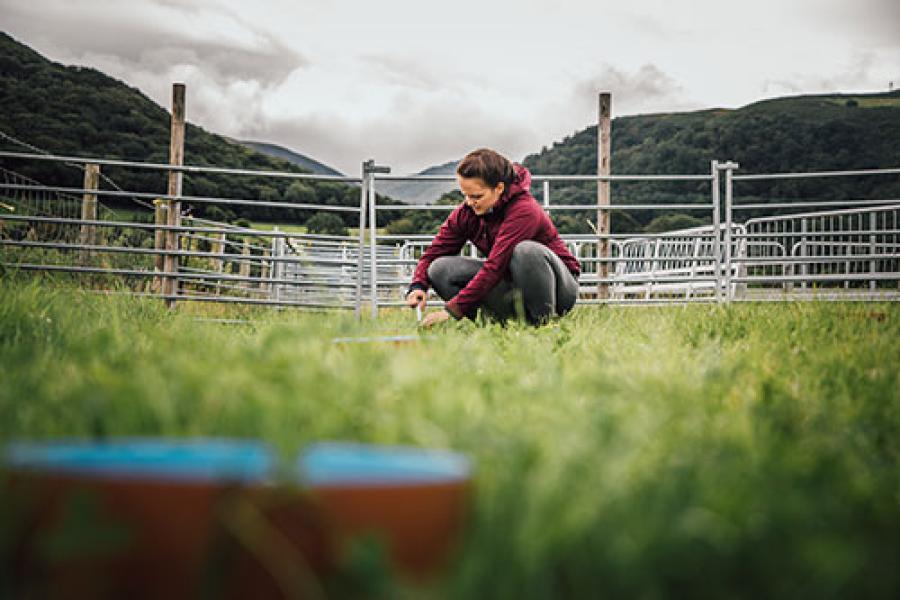
- an active research farm with alpaca, sheep and bee hives
Got any questions? Chat to students and staff

Do you have a question about life as a Bangor University student? Our ambassadors will be happy to help you find the answer.
They can tell you more about studying here, about the amazing Clubs and Societies we have, and how they made friends and settled in to life at university.
If you have any questions about the course, our lecturers are on hand to help. Below are some examples of frequently asked questions. Can you think of any more?
- What are the qualities of a successful student in this subject at Bangor?
- How can I prepare myself to study this subject at Bangor?
- How will I know that this subject at Bangor is the right choice for me?

Our Research in Environmental Science
Bangor University has been at the forefront of research in the environmental sciences for decades. The diversity of staff interests and expertise mean that our research helps provide answers to fundamental theoretical and applied problems in the environmental sciences, as well as directing our teaching.
Where is Bangor?

You may also be interested in these related subject areas.
You may also be interested in these related subject areas.


