
Jewish history in Wales stretches back centuries, yet its significance remains little known outside specialist circles.
My new book uncovers how Jews, Judaism, Israel and Palestine have played a far greater role in Welsh history and imagination than many realise. In fact, they have helped shape ideas of nationhood, identity and belonging over centuries.
In her 2012 book Whose People? Wales, Israel, Palestine, the scholar Jasmine Donahaye observed that “the fate of Jews in Britain had been historically closely caught up with the fate of the Welsh, though this seems to have passed largely unnoticed in Wales”.
My research builds on that insight, tracing Wales’s relationship with Jews, Judaism, Israel and Palestine from the earliest historical references to the present day. My research shows that these connections have been far more significant than historians have generally acknowledged.
The subject has often been overlooked. While scholarship on Jewish life in Wales has grown in recent decades, Wales has generally been absent from wider studies of Jewish history and antisemitism in Britain, which have tended to focus on England.
But the Welsh connection with Jews and Judaism stretches back much further than many people might imagine.
The first contact between Wales and Jewish culture appears to date from the Roman period with the discovery of a Graeco-Hebrew amulet in the Roman camp of Segontium in present-day Caernarfon, in north-west Wales. By the medieval era, Jews were already woven into Welsh political, economic and religious life.
Medieval encounters
Jewish communities existed in parts of Wales before the expulsion of Jews from England in 1290, though they may have been excluded from some Welsh territories even earlier.
Medieval records show Jewish financiers helping to fund major Welsh building projects. In the 1190s, the bishops of Bangor borrowed money from Aaron of Lincoln, one of the wealthiest Jewish financiers in medieval England, to support construction work at Bangor Cathedral.
At the same time, Welsh history was indirectly shaped by anti-Jewish policies pursued by English rulers.
During his conquest of Wales in the 13th century, Edward I imposed heavy taxes on England’s Jewish population to help fund his military campaigns and the construction of the “iron ring” of castles that secured his rule. After defeating Llywelyn ap Gruffudd, the last native prince of Wales, Edward expelled the Jews from his kingdom in 1290, allowing the crown to seize debts owed to Jewish lenders.
But even after Jews disappeared from Wales physically, they remained highly visible in the Welsh imagination.
Medieval Welsh poetry and religious writing frequently portrayed Jews through negative Christian stereotypes, including accusations of usury and responsibility for the death of Jesus. One of the most influential medieval anti-Jewish texts in Britain, The Life and Miracles of St William of Norwich, was written around 1150 by the Welsh monk Thomas of Monmouth.
The text helped spread the false “blood libel” accusation that Jews murdered Christian children for ritual purposes. It was a myth that fuelled anti-Jewish prejudice across medieval Europe.
However, Welsh attitudes towards Jews were often contradictory.
From the early modern period onwards, many Welsh writers and theologians developed a fascination with the Jewish people and the lands of the Bible. Travellers and clergy drew comparisons between the landscapes of Wales and those of the Holy Land. Some even argued that Welsh descended from Hebrew or that the Welsh people were one of the lost tribes of Israel.
This admiration for Jewish history and scripture – sometimes described as philosemitism – often existed alongside a desire to convert Jews to Christianity. Welsh Protestant and evangelical movements were particularly active in missionary work aimed at Jewish communities abroad.
The influence of Jewish culture can also be found in the history of the Welsh language itself. The 1588 translation of the Bible into Welsh, based in part on Hebrew texts, played a crucial role in preserving and standardising Welsh at a time when the language faced serious threats.
Centuries later, Welsh language campaigners looked with admiration at the revival of Hebrew as a spoken national language in Israel. The Hebrew term ulpan was even borrowed for intensive Welsh language-learning programmes.
Welshmen in the Middle East
The Holy Land occupied a special place in Welsh religious life for centuries. It was a destination for pilgrims and the source of one of the country’s most treasured religious relics: the Cross of Neith, believed to contain a fragment of the true cross on which Jesus was crucified.
Welsh involvement in the region was not confined to devotion and storytelling either. The medieval Crusades were a series of religious military campaigns launched by western European Christians between 1095 and 1291, primarily aimed at reclaiming the Holy Land from Muslim control. Welsh soldiers played a role in some of those campaigns, linking Wales directly to some of the most consequential events in the region’s history.
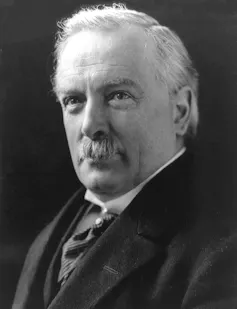

In the 20th century, Welsh figures helped shape the modern Middle East. For example, in 1917, prime minister David Lloyd George oversaw the government that issued the Balfour declaration, which supported the establishment of a national home for the Jewish people in Palestine.
At the same time, the Welsh-born officer T. E. Lawrence was supporting Arab nationalist aspirations in the region. The tensions between those competing promises would have consequences that continue to resonate today.
Following the collapse of the Ottoman Empire, Britain governed Palestine between 1920 and 1948. Welsh soldiers, administrators, writers and settlers all became involved in that history. Some are buried in Israel today. A Welsh-speaking society was even established in Jerusalem during the second world war.
The relationship between Wales and Jews, Judaism, Israel and Palestine is about more than diplomatic history or religious belief. It is also a story about how Welsh people have understood themselves.
This article features references to books that have been included for editorial reasons, and may contain links to bookshop.org. If you click on one of the links and go on to buy something from bookshop.org The Conversation UK may earn a commission.